
 716.874.3000
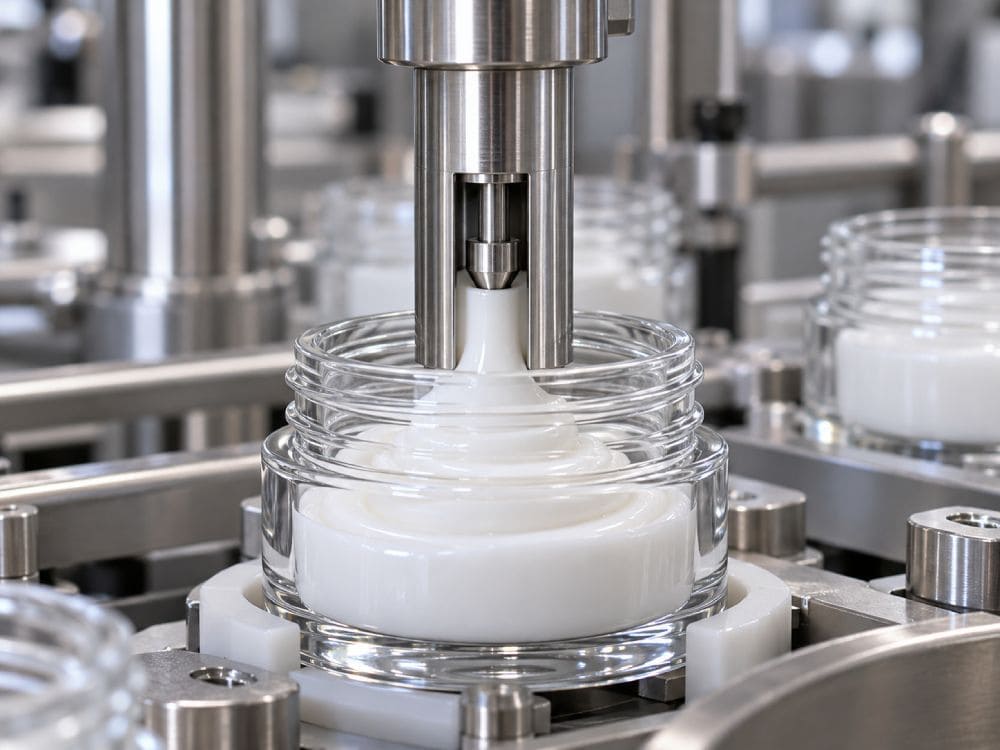
Filling thick, viscous products sounds straightforward until you actually try it. What works perfectly for water, juice, or light oil becomes a frustrating mess when you introduce a heavy cream, a dense syrup, a gel, or an industrial adhesive. Products string, drip, clog nozzles, and resist flow in ways that standard gravity or overflow fillers simply cannot handle.
If you're running a production line with high-viscosity materials, the machine selection process looks completely different than it does for thin liquids. The wrong choice doesn't just hurt accuracy—it can bring your line to a standstill.
In this guide, we'll walk through what makes viscous products difficult to fill, which filling technologies are built for the job, and what factors to weigh before you invest in viscous liquid filling equipment.
In this guide:
- Why Viscous Products Are Difficult to Fill
- Filling Machine Types for High-Viscosity Products
- Key Factors to Consider When Selecting Viscous Liquid Filling Equipment
- Common High-Viscosity Products & Recommended Equipment
- FAQs
Why Viscous Products Are Difficult to Fill
Most filling machines are designed around the assumption that product will flow readily through a nozzle under gravity or light pressure. Viscous materials break that assumption at every step. Understanding why helps you avoid the common mistake of buying a machine that simply isn't built for your product.
The Core Challenge: Resistance to Flow
Viscosity is a measure of a fluid's resistance to flow. Thin liquids like water or juice move freely with minimal force. Thick products like creams, honey, heavy gels, and industrial adhesives resist movement and need to be pushed, pulled, or pressurized into the container rather than flowing on their own.
Products on the thicker end of the spectrum won't move through a standard nozzle without assistance. That's why high-viscosity applications require positive-displacement filling technology rather than gravity or overflow systems, which depend entirely on a product's ability to flow freely.
Common Problems with Viscous Filling
When you run a thick product through the wrong machine, a few things tend to go wrong:
- Stringing and dripping: Viscous products resist clean cutoff, leaving threads or tails that contaminate containers and create waste.
- Air entrapment: Thick materials can trap air pockets during filling, causing inaccurate fills and product quality issues.
- Nozzle clogging: Heavy pastes and gels can harden or set in nozzles during downtime or between fills.
- Inconsistent fill weights: Without positive displacement, flow rates fluctuate as viscosity shifts with temperature.
- Pump slippage: Certain pump types lose accuracy as product thickness increases.
How Temperature Affects Viscosity
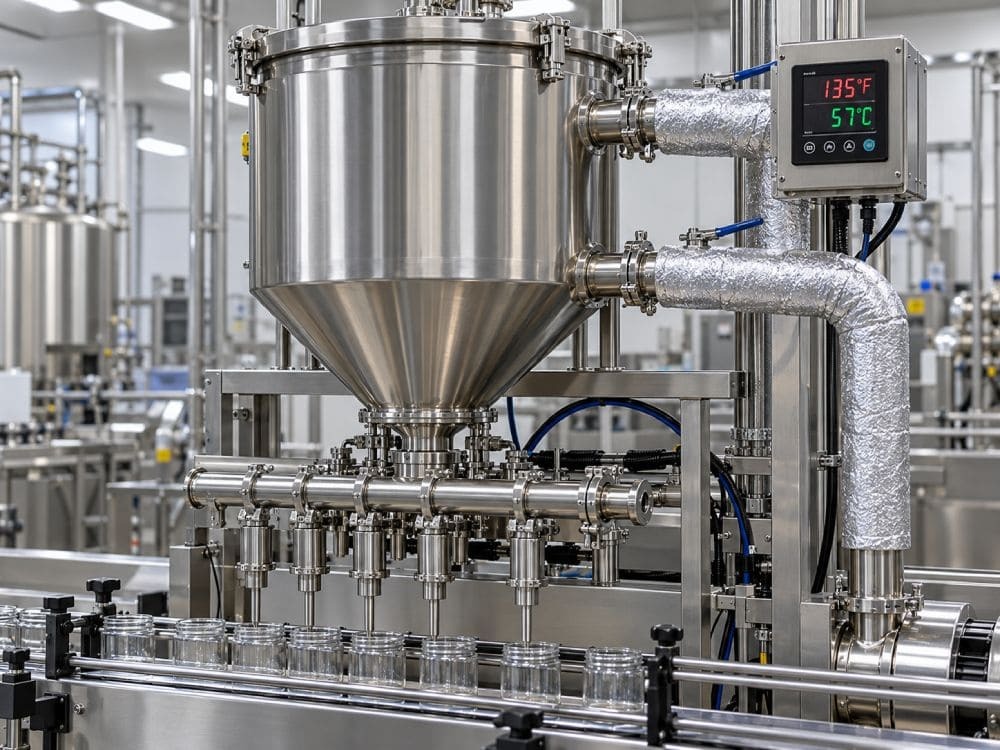
One factor that catches a lot of manufacturers off guard is that viscosity is not a fixed property. The same product can behave very differently depending on temperature. A lotion that flows reasonably well when warm can become significantly thicker at room temperature. That shift can change which machine technology is appropriate.
This is why many viscous filling systems include jacketed hoppers, heated product lines, or temperature-controlled fill heads. Keeping your product at a consistent temperature during filling isn't just a quality concern—it's a machine selection factor.
Filling Machine Types for High-Viscosity Products
Not all filling machines are created equal when it comes to thick materials. There are several proven technologies specifically designed for high-viscosity applications. Each filling machine type has its strengths, and the right choice depends on your specific product, production volume, and how the material behaves during filling.
Piston Fillers
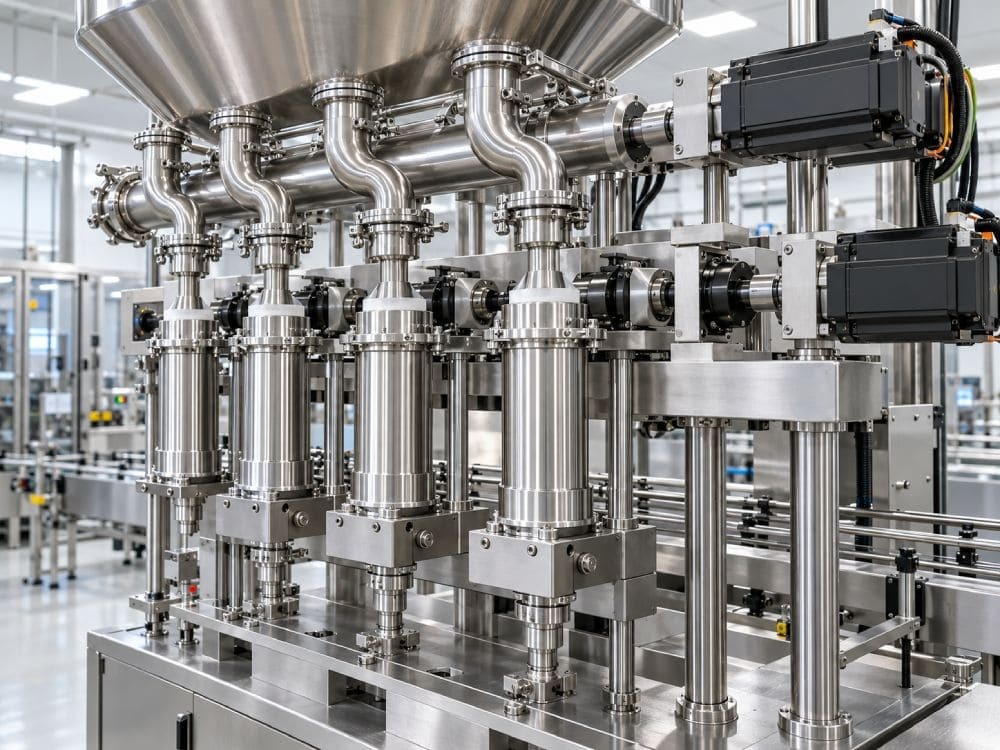
Piston fillers are the most widely used technology for viscous liquid filling equipment, and for good reason. A piston draws a precise, measured volume of product into a cylinder, then pushes it out through the nozzle on the forward stroke. Because fill volume is controlled mechanically rather than by flow rate, piston fillers maintain consistent accuracy even as viscosity changes.
Best for: Creams, lotions, sauces, gels, thick syrups, and pastes
Why they work: The mechanical displacement means the machine doesn't rely on the product flowing freely. Adjustable stroke length allows easy volume changes between SKUs, and large-bore nozzle options accommodate chunky or particulate-laden products. Servo-driven versions offer recipe storage and fast changeover.
The main trade-off is speed. Piston fillers operate in discrete strokes rather than continuous flow, so they run slower than pump-based systems. For most viscous filling applications, the accuracy and versatility more than make up for it.
Pump Fillers
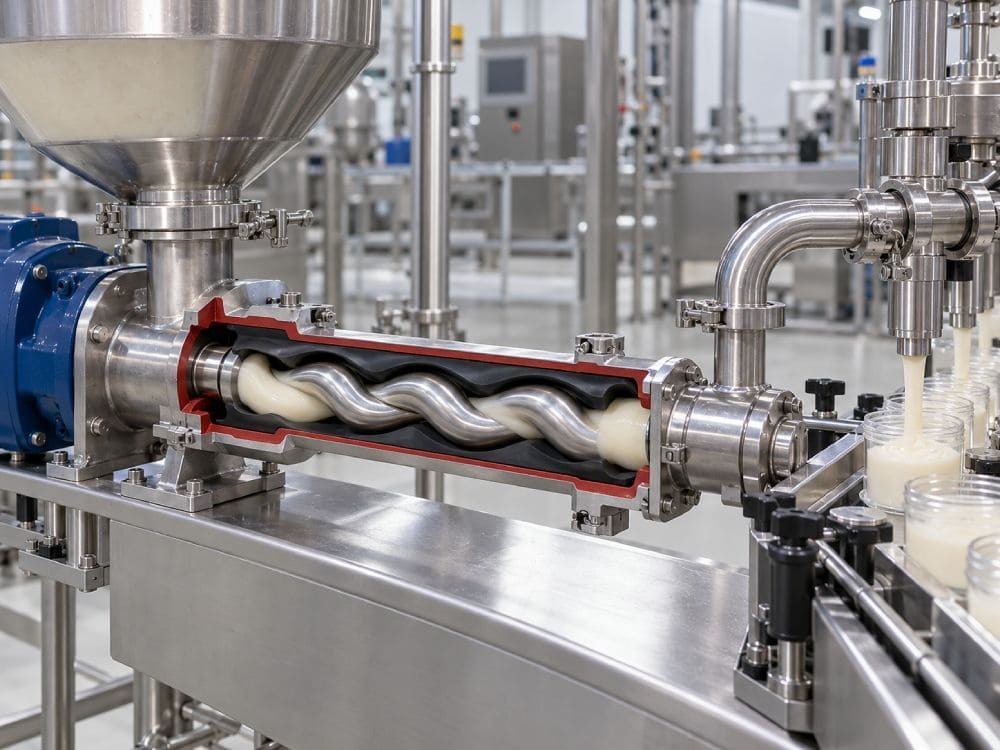
Pump-based fillers move product continuously through a pump mechanism rather than in measured strokes. Several pump types are suited to viscous applications, each handling thick materials a bit differently.
Best for: Medium to high-viscosity products, shear-sensitive formulas, and applications requiring continuous flow
Key pump types for viscous products:
- Progressive cavity (PC) pumps: Handle extremely thick products and are gentle on shear-sensitive formulas like emulsions and enzyme blends. A strong choice for very heavy creams, adhesives, and semi-solids.
- Gear pumps: Compact and consistent for medium-viscosity liquids like detergents, oils, and thinner cosmetic formulas. Less suitable for very thick products or those with particulates.
- Lobe pumps: A gentle, high-volume option well suited to products with soft particulates or pulps. Common in food and personal care applications.
- Peristaltic pumps: Product contacts only the tubing, making them ideal for sanitary or pharmaceutical applications. Best suited to moderate viscosities and lower throughputs.
Auger Fillers
For products that are more semi-solid than liquid—including thick pastes, putties, or certain adhesive compounds—an auger filler may be the right call. A rotating screw moves product down through a tube and into the container, handling materials that would stall a piston or pump system.
Best for: Very thick semi-solids, pastes, and materials that don't flow under normal conditions
Why they work: Auger fillers generate the mechanical force needed to move materials that simply won't respond to pressure or suction alone. The trade-off is that they are typically less accurate than piston fillers and can require more involved cleaning between product changeovers.
Comparison at a Glance
|
Technology |
Best Products |
Key Strength |
|
Piston Filler |
Creams, gels, sauces, pastes |
High accuracy, handles wide viscosity range |
|
Progressive Cavity Pump |
Heavy creams, adhesives, semi-solids |
Gentle on shear-sensitive products |
|
Gear Pump |
Oils, detergents, thinner cosmetics |
Compact, consistent for medium viscosity |
|
Lobe Pump |
Products with soft particulates |
Gentle, high-volume |
|
Peristaltic Pump |
Pharma, biotech, sanitary applications |
No product contact with machine components |
|
Auger Filler |
Putties, very thick pastes |
Handles materials that won't flow at all |
Key Factors to Consider When Selecting Viscous Liquid Filling Equipment
Choosing the right machine isn't just about matching a product type to a technology. There are several other variables that will shape your decision, and getting any one of them wrong can be expensive to fix after the fact. Here's what we walk through with every customer who comes to us with a viscous filling application.
Your Product's Behavior
Start here, always. Before you talk to any equipment manufacturer, understand how your product actually behaves during filling. Know whether it's shear-sensitive, meaning it can break down or change texture if agitated too aggressively. Know whether it contains particulates, fibers, or chunks, and how large they are. Know how your product responds to temperature, since viscosity can shift significantly between a cold warehouse and a warm production floor. These details aren't just background information. They can eliminate several machine types from consideration before you ever look at a spec sheet.
Required Fill Accuracy
Different industries and products have different fill accuracy requirements. A food product may tolerate more variation than a pharmaceutical or a high-value cosmetic formula. Piston fillers and net-weight systems generally deliver the tightest accuracy for viscous applications. If your product is expensive, regulated, or sold by weight, accuracy should be a primary selection driver, not an afterthought.
Production Speed & Volume
How many containers per minute do you need to fill? Viscous products naturally slow things down compared to thin liquids, but there's still a wide range depending on the technology and configuration you choose. If you need higher throughput, a multi-head configuration or a pump-based system may be a better fit than a single-head piston filler.
A quick guide to automation level by volume:
- Lower volume operations: Semi-automatic filling is often the most cost-effective starting point
- Mid-volume operations: Inline automatic with multiple fill heads suits most growing production lines
- High-volume operations: High-speed inline or rotary configurations with multiple heads
Nozzle Design & Anti-Drip Features
This is one of the most overlooked factors in viscous filling. The nozzle is where stringing, dripping, and air entrapment actually happen. For thick products, you want:
- Large-bore nozzles to allow product to move without restriction
- Anti-drip or shut-off valves that cut cleanly at the end of each fill cycle
- Dive nozzles that lower into the container before filling, reducing air entrapment and splashing
- Nozzle heating for products that set or harden at room temperature
Cleanability & Changeover
If you run multiple products or formulas on the same line, cleanability is a major operational factor. Viscous products can be difficult to clean from hoppers, lines, and nozzles. Look for machines with clean-in-place (CIP) capability, minimal dead legs in the product path, and tool-free disassembly for manual cleaning when needed.
Changeover time matters too. Servo-driven piston fillers with recipe storage can switch between fill volumes in minutes. Manually adjusted machines take considerably longer, which adds up quickly on a multi-SKU line.
Common High-Viscosity Products & Recommended Equipment
Every viscous product has its own filling personality. Here's how we typically approach equipment selection for some of the most common high-viscosity applications we see.
Creams, Lotions, & Cosmetic Formulas
Cosmetic creams and lotions are among the most common viscous filling applications. They're thick enough to need positive displacement, but many are also shear-sensitive, meaning aggressive pumping can break the emulsion and ruin the product's texture.
Recommended approach: Servo-driven piston fillers work well for most cosmetic creams, offering the accuracy and gentle handling these formulas require. For very heavy body butters or products with suspended particles, a progressive cavity pump is worth considering.
Syrups, Honey, & Thick Food Products
Food-grade viscous products add a layer of complexity. Sanitation requirements are stricter, and many products like honey or thick sauces behave very differently depending on temperature. Warm honey fills much more easily than cold honey, so temperature control at the hopper and fill head is often necessary.
Recommended approach: Piston fillers with food-grade stainless steel construction and heated hoppers handle most thick syrups and honey applications effectively. Large-bore nozzles with anti-drip valves keep fills clean and consistent.
Adhesives, Sealants, & Industrial Compounds
Industrial adhesives and sealants sit at the heavy end of the spectrum. Many are also reactive, meaning they can begin to cure if left in the nozzle or product path too long. These applications often require specialized materials in the pump and nozzle components to resist chemical attack.
Recommended approach: Progressive cavity pumps or heavy-duty piston fillers with large-diameter cylinders are the standard choice. Heated product lines help maintain consistent flow during filling. Cleaning protocols between runs are critical to prevent product from setting in the machine.
Gels, Ointments, & Pharmaceutical Products
Pharmaceutical gels and ointments combine high viscosity with strict accuracy and cleanliness requirements. FDA compliance, material traceability, and CIP capability are non-negotiable in this category.
Recommended approach: Piston fillers with pharmaceutical-grade stainless steel construction, validated fill accuracy, and full CIP capability are the standard for this application. Peristaltic pumps are also used when product contact must be limited to a single, disposable component.
Frequently Asked Questions
What Is the Best Filling Machine for Thick Liquids?
The best filling machine for thick liquids depends on your product's viscosity, shear sensitivity, and accuracy requirements. For most high-viscosity applications, a piston filler is the most reliable and accurate choice. It delivers consistent fill volumes across a wide viscosity range and handles products that won't flow freely on their own.
What Type of Viscous Liquid Filling Equipment Handles Shear-Sensitive Products?
Shear-sensitive products require low-shear filling technology. The best options are servo-driven piston fillers, which apply gentle, controlled pressure, and progressive cavity (PC) pumps, which move product smoothly without high-speed rotation. Gear pumps are generally not recommended for shear-sensitive applications, as the internal forces can break emulsions and degrade product texture.
How Do I Fill High-Viscosity Products Accurately?
Accurate filling of high-viscosity products requires positive-displacement technology, which controls fill volume mechanically rather than relying on flow rate. Piston fillers are the most widely used choice for this reason. To maintain accuracy, it's also important to keep product temperature consistent during filling, since viscosity changes with temperature and can cause fill weights to drift. Using a heated hopper and jacketed product lines helps stabilize viscosity throughout the production run.
What Is the Best Filler for Heavy Liquids?
For very heavy liquids and paste-like materials, the best options are heavy-duty piston fillers with large-bore cylinders or progressive cavity pumps. These technologies generate the pressure needed to move extremely viscous materials through the fill head without sacrificing consistency. For semi-solid products that don't flow at all, an auger filler may be required. In all cases, heated product lines and anti-drip nozzles are strongly recommended to keep the filling process clean.
Can a Standard Filling Machine Handle Viscous Products?
Standard gravity or overflow filling machines are designed for thin, free-flowing liquids and are not suitable for viscous products. Attempting to run a thick cream, syrup, or gel through a gravity filler will result in inconsistent fills, product waste, and potential machine damage. Products on the thicker end of the viscosity spectrum require a positive-displacement filling system specifically designed to handle thick materials.
Ready to Find the Right Filling Machine for Your Product?
Viscous filling isn't a one-size-fits-all problem. The right equipment depends on your specific product, your production volume, your accuracy requirements, and the operational realities of your facility. Getting those details right before you buy saves significant time, money, and frustration down the line.
At Oden Machinery, we've helped manufacturers across pharmaceuticals, personal care, food, and industrial chemicals find the right filling solution for their most challenging products. Whether you're starting from scratch or upgrading an existing line, we'll work through the details with you and recommend a system that fits your application.
Contact Oden Machinery today to discuss your viscous filling requirements. Tell us about your product, your containers, and your production targets, and we'll help you find the right equipment.
