
 716.874.3000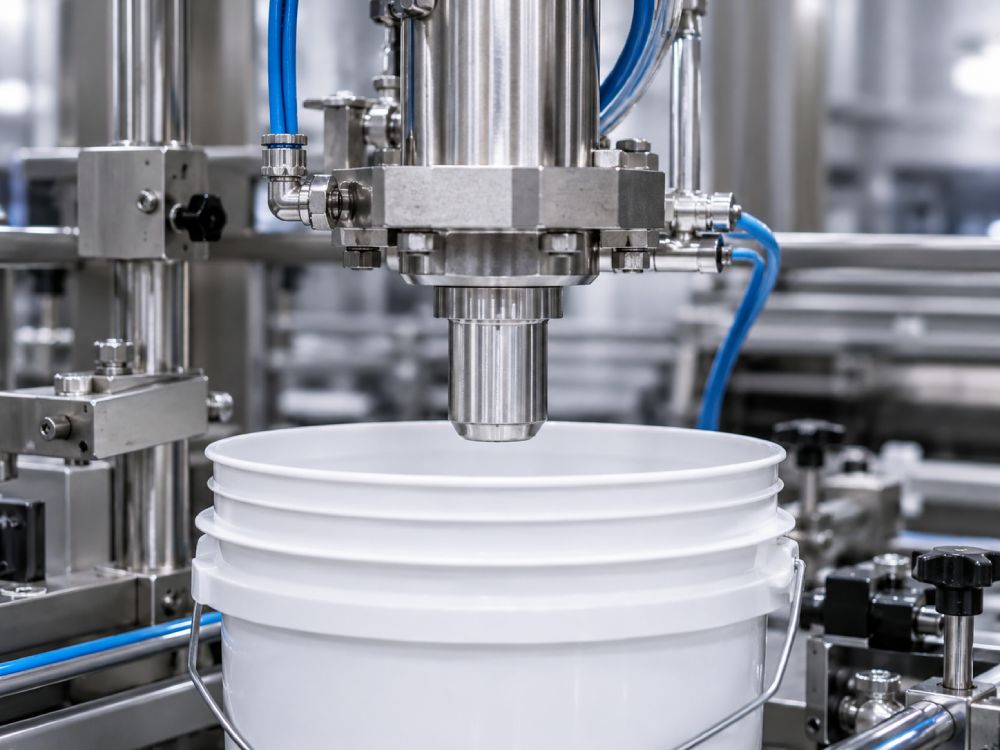
Choosing the right container format is one of the most important decisions in a liquid packaging operation. Get it right and the line runs efficiently, product moves cleanly, and costs stay in check. Get it wrong and the operation ends up fighting the equipment every shift.
Pail filling and IBC filling are two of the most common approaches for handling bulk and mid-volume liquid products. They serve different production environments, different customer requirements, and different operational priorities. Understanding how each one works, where each one fits, and what separates them in practice can help manufacturers make a more informed decision before investing in new equipment or reconfiguring an existing line.
In this article, we'll break down what pail filling and IBC filling are, the benefits and applications of each, how they compare across the factors that matter most, and what to consider when choosing between them.
What Is Pail Filling?
Pail filling is the process of dispensing liquid, semi-liquid, or viscous product into rigid, open-head containers, most commonly ranging from 1 gallon to 6 gallons. Five-gallon pails are the most widely used format. These containers are made from steel or plastic, sealed with a snap-on or press-on lid, and designed for easy handling, stacking, and retail or industrial distribution.
Pail fillers can be manual, semi-automatic, or fully automatic depending on production volume and automation requirements. The fill cycle typically involves positioning the empty pail under the fill head, dispensing product by weight or volume, and then transferring the filled container to a closing station for lid placement and pressing.
The equipment used in a pail filling line may include a filler with a net-weight or volumetric fill system, a pump, product-feed hoses and nozzles, a pail closer, a conveyor or roller bed, and downstream labeling and coding equipment.
Benefits of Pail Filling
Pail filling offers several advantages that make it the right choice for a wide range of liquid packaging operations.
- Flexibility Across Product Types: Pail fillers handle a broad range of viscosities, from thin, free-flowing liquids to thick coatings, adhesives, and gels. The right pump and nozzle configuration can be matched to the product.
- Retail and Distribution-Friendly Format: Pails are easy to transport, stack, and store. They are a familiar format for end users in industrial, commercial, and consumer markets.
- Scalable Automation: Operations can start with semi-automatic equipment and scale toward full automation as volume increases. The container format supports a wide range of line configurations.
- Lower Container Cost: Pails are generally less expensive than IBCs on a per-unit basis and are widely available from multiple suppliers.
- Easier Handling for Smaller Batches: Because pails are lighter and more manageable than bulk containers, they are practical for operations that fill a variety of products in shorter runs.
Common Applications for Pail Filling
Pail filling is used across a wide range of industries and product categories. Common applications include:
- Paints, coatings, and architectural finishes
- Adhesives, sealants, and caulks
- Lubricants and greases
- Industrial and commercial cleaning compounds
- Food-grade products such as icing, fats, and sauces
- Agricultural chemicals and pesticides
- Automotive fluids and specialty chemicals
- Personal care and cosmetic formulations in bulk
Filling Methods Used in Pail Filling
The right fill method depends on the product, required accuracy, and production speed.
- Net-weight filling is one of the most common approaches for pails. The system fills based on the actual weight of product dispensed into the container, using load cells to monitor and control the fill. This method works well for products sold by weight and for applications where container tare weights vary.
- Volumetric filling dispenses a fixed volume of product per cycle. It can be a good fit for free-flowing liquids with consistent density where volume and weight are closely correlated.
- Pump-based filling uses a metered pump to deliver product to the container. The pump type is selected based on viscosity, abrasiveness, and product sensitivity.
What Is IBC Filling?
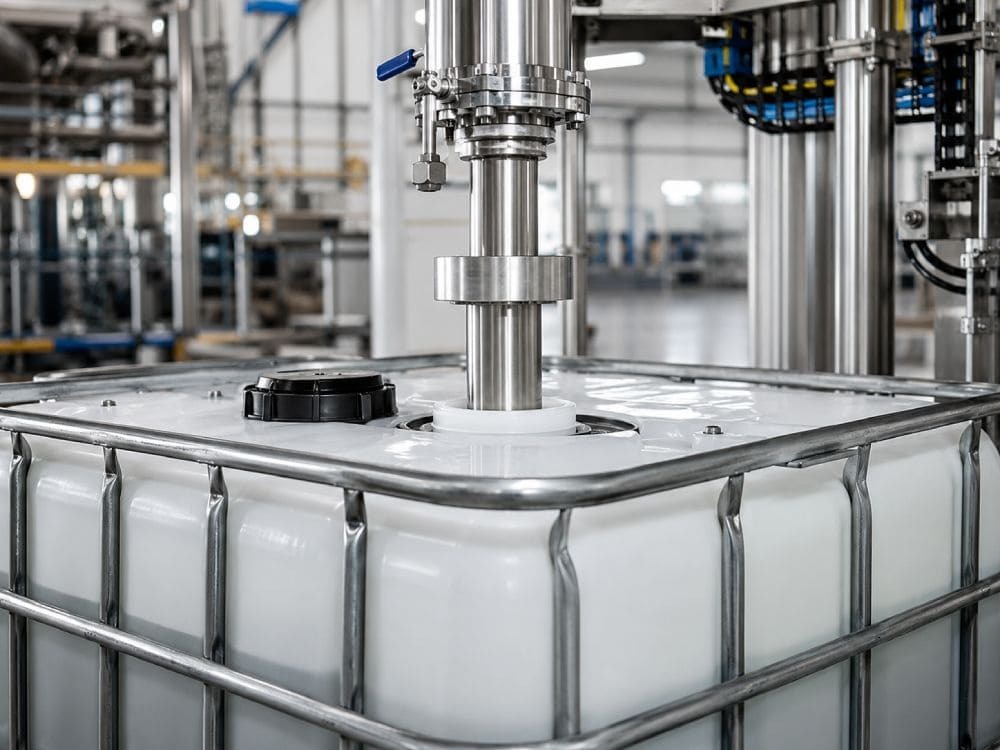
IBC filling is the process of dispensing large volumes of liquid or semi-liquid product into intermediate bulk containers. IBCs are rigid, reusable containers typically holding 275 to 330+ gallons. They consist of a plastic inner bottle housed in a metal cage frame, mounted on a pallet base for forklift handling and warehouse storage.
IBCs are designed for bulk product movement. They are used when the goal is to move large quantities of liquid efficiently between production, storage, distribution, and end-use locations without the labor and handling involved in managing dozens of smaller containers.
IBC filling equipment varies in complexity. Some operations use a semi-automatic filler positioned above the IBC with gravity or pump-assisted flow. Others use fully automated systems with load cells, integrated controls, and automated valve management to fill multiple IBCs per shift with minimal operator involvement.
Benefits of IBC Filling
IBC filling is well-suited for operations that prioritize throughput, bulk handling efficiency, and reduced labor per unit of product moved.
- High Volume per Fill Cycle: A single IBC holds the equivalent of 55 to 66 standard five-gallon pails. Filling one IBC moves significantly more product per cycle than filling individual pails.
- Reduced Labor per Unit of Product: Fewer containers to fill, close, label, move, and stack means less labor per gallon of product packaged.
- Forklift-Compatible Handling: IBCs are built on pallet bases and move easily with standard forklifts or pallet jacks, which reduces manual lifting and ergonomic strain.
- Reusable Containers: Many IBC formats are designed for multiple use cycles, which can reduce per-fill container cost over time for operations with closed-loop distribution.
- Reduced Secondary Packaging: Because IBCs hold large volumes, there is less need for individual lids, labels, and closures per unit of product compared to pail operations.
- Efficient for Bulk Transfer and Storage: IBCs are a practical solution for moving product between production and distribution, storing bulk intermediates, or shipping large volumes to industrial customers.
Common Applications for IBC Filling
IBC filling is widely used in industries that move product in bulk quantities. Common applications include:
- Chemical manufacturing and distribution
- Industrial lubricants and process fluids
- Food-grade ingredients, syrups, and liquid additives
- Agricultural chemicals and liquid fertilizers
- Paints, coatings, and resins in bulk
- Pharmaceutical and nutraceutical intermediates
- Cleaning and sanitation chemicals
- Water treatment and industrial process chemicals
Filling Methods Used in IBC Filling
IBC filling uses many of the same underlying fill technologies as pail filling, but the larger container size and higher fill volumes introduce different considerations.
- Net-weight filling is common for IBCs, particularly when the product is sold by weight or when tight fill accuracy is required. Load cells are placed under the IBC during filling, and the system cuts off flow when the target weight is reached.
- Flow meter filling uses a calibrated flow meter to measure the volume of product dispensed. This approach can work well for free-flowing liquids where density is consistent.
- Gravity filling is sometimes used for thin, free-flowing products where the product supply is elevated above the IBC and flow is controlled by a valve. This approach is simple but less accurate than weight- or meter-based systems.
Pail Filling vs. IBC Filling: A Side-by-Side Comparison
Both pail filling and IBC filling are well-established approaches to liquid packaging. The right choice depends on production volume, customer requirements, product characteristics, facility layout, and how product is ultimately used or distributed. The table below compares the two formats across the factors that matter most.
|
Factor |
Pail Filling |
IBC Filling |
|
Typical container size |
1 to 6 gallons (5-gallon most common) |
275 to 330 gallons (standard tote) |
|
Fill volume per cycle |
Low to moderate |
High |
|
Labor per gallon filled |
Higher |
Lower |
|
Container cost |
Lower per unit |
Higher per unit |
|
Container handling |
Manual or conveyor |
Forklift or pallet jack |
|
End-use format |
Retail, commercial, industrial distribution |
Bulk industrial, internal transfer, large-volume customers |
|
Closure requirements |
Lid pressing, capping, plugging |
Bung cap, top fill port seal |
|
Labeling needs |
Full label, barcode, compliance markings |
Minimal per container; often placard or sticker |
|
Facility space requirements |
Moderate (line-based) |
Larger (forklift clearance required) |
|
Changeover complexity |
Moderate (product, nozzle, guide rail) |
Moderate (product, valve, cleaning) |
|
Automation options |
Manual, semi-auto, fully automatic |
Semi-auto, fully automatic |
|
Reusability |
Single use (typically) |
Designed for multiple use cycles |
|
Best fit for |
Mid-volume, multi-SKU, retail or trade distribution |
High-volume, bulk transfer, industrial customers |
When Pail Filling Makes More Sense
Pail filling tends to be the better fit when:
- The product is sold to end users who need manageable quantities for application
- The operation fills multiple products or SKUs and needs changeover flexibility
- Customers expect retail-ready or trade-ready packaging with full labeling
- Production volume is moderate and containers need to move through a full packaging line
- The product requires precise fill weights for compliance or customer specifications
- Space is limited and a full IBC forklift staging area is not practical
When IBC Filling Makes More Sense
IBC filling tends to be the better fit when:
- The product is sold or transferred in bulk to industrial customers or internal facilities
- Reducing labor per gallon filled is a priority
- The operation fills high volumes of a single product or a small number of products
- The customer or end use requires large-volume delivery with minimal packaging overhead
- The facility has the forklift infrastructure and floor space to support IBC movement
- Reusable containers align with the distribution model or sustainability goals
Can an Operation Run Both?
Some facilities fill both pails and IBCs, either on the same equipment or on separate lines. This is common when a manufacturer sells the same product in multiple formats, such as retail five-gallon pails for contractors and bulk IBCs for large industrial accounts.
Running both formats adds complexity to scheduling, changeover, cleaning, and equipment selection. If both formats are needed, the product characteristics, fill accuracy requirements, and cleaning demands of each format need to be evaluated together before equipment is selected. A thorough packaging line assessment before committing to equipment can prevent costly mismatches down the line.
Key Factors to Consider When Choosing Between Pail & IBC Filling
The comparison table gives a useful overview, but the real decision comes down to how these factors apply to a specific operation. Before selecting equipment or committing to a container format, manufacturers should work through the following considerations carefully.
Product Characteristics
The product itself is often the starting point. Viscosity, foaming behavior, particulate content, temperature sensitivity, abrasiveness, and chemical compatibility all affect how product can be moved, filled, and contained. Some products are well-suited for either format. Others may create handling challenges in one format that the other avoids.
A thick adhesive that moves slowly through a pump may be more practical in pails, where smaller fill volumes mean shorter fill cycles and less dwell time in the product path. A thin, free-flowing chemical that needs to move in large volumes quickly may be a better fit for IBC filling.
Customer & Distribution Requirements
How the product reaches the end user matters as much as how it is produced. If customers order in pail quantities, receive product at job sites, or require retail-ready packaging, pails are the right format. If customers are industrial facilities receiving bulk deliveries by the tote, IBC filling is more appropriate.
Some manufacturers do not have a choice because the customer specifies the container format. In those cases, the equipment decision follows from the customer requirement, not the other way around.
Production Volume
Volume is one of the clearest indicators of which format fits. Pail filling is practical across a wide range of volumes, from small batches to high-volume automated lines. IBC filling becomes more compelling as volume increases, because the labor efficiency advantage grows with the number of gallons filled per shift.
If an operation fills 500 gallons per day, the difference in labor between pails and IBCs may be manageable. If an operation fills 10,000 gallons per day, the labor cost of handling individual pails becomes significant. At high volumes, IBC filling can meaningfully reduce the number of containers handled, closed, labeled, and staged per shift.
Facility Layout & Infrastructure
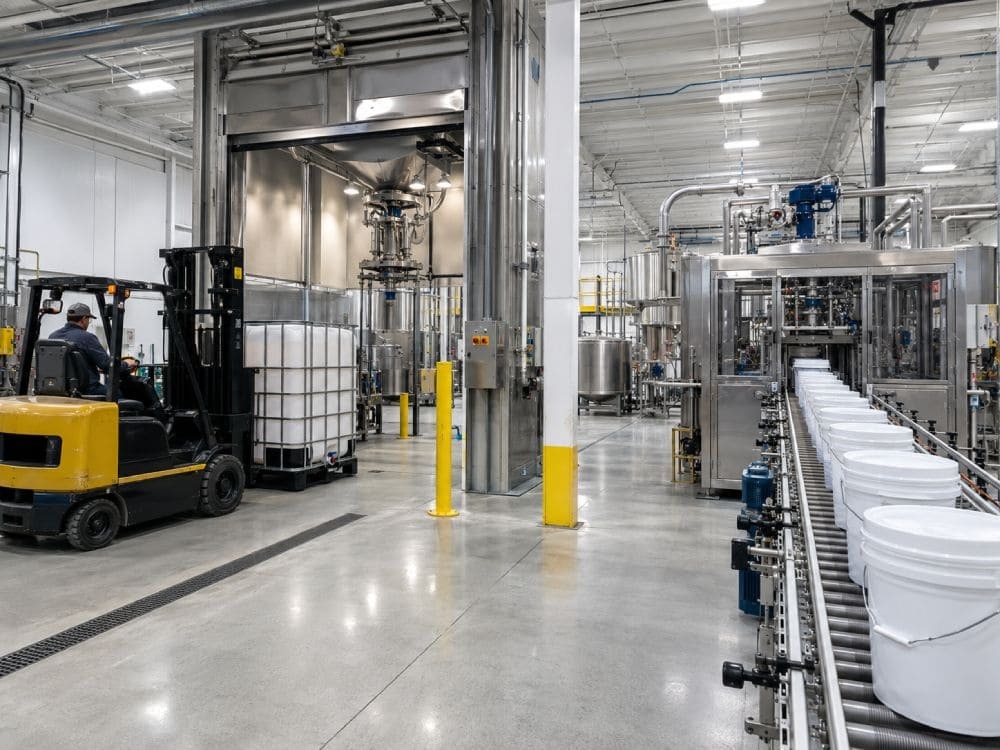
The physical environment affects what is practical. Pail filling lines require space for conveyors, staging areas, lid supply, and downstream handling. IBC filling requires forklift access, sufficient ceiling height for overhead fill heads, and floor space for positioning and staging IBCs.
A facility that was not designed for forklift traffic or that has limited ceiling clearance may not be well-suited for IBC filling without modifications. A facility with a tight floor plan but good conveyor access may be a better fit for a pail line.
Changeover Requirements
Operations that fill multiple products need to think carefully about changeover. Pail lines typically involve changing nozzles, adjusting guide rails, updating recipes, swapping labels, and cleaning product-contact parts. IBC filling changeovers involve cleaning the fill head, hoses, valves, and product path, which can be more involved depending on the products.
If the operation runs many different products with tight turnaround between runs, pail filling may offer more practical flexibility. If the operation runs fewer products in longer runs, IBC filling changeover demands are easier to manage.
Regulatory & Compliance Considerations
Some products are subject to regulations that specify container formats, labeling requirements, or fill accuracy tolerances. Hazardous materials, food-grade products, and pharmaceutical ingredients may have specific requirements that influence the container decision.
Before selecting a format, manufacturers should confirm that the chosen container meets any applicable regulatory requirements for the product, industry, and distribution region.
Pail Filling vs. IBC Filling: FAQs
What Is the Main Difference Between Pail Filling and IBC Filling?
The main difference is container size and the production environment each format is designed for. Pail filling fills small rigid containers, typically one to six gallons, and is suited for retail, commercial, and trade distribution. IBC filling fills large intermediate bulk containers, typically 275 to 330 gallons, and is suited for bulk industrial transfer and high-volume production. The equipment, line layout, handling requirements, and labor demands are different for each format.
Which Format Is More Cost-Effective?
The answer depends on the operation. Pails have a lower per-unit container cost, but filling, closing, labeling, and handling a large number of individual pails requires more labor per gallon of product packaged. IBCs have a higher per-unit cost but reduce labor and handling significantly at high volumes. For operations moving large quantities of product to bulk customers, IBC filling is often more cost-effective overall. For operations with moderate volumes, diverse SKUs, or retail distribution, pail filling typically makes more sense.
Can the Same Filler Be Used for Both Pails and IBCs?
In most cases, no. Pail fillers and IBC fillers are designed around different container sizes, fill volumes, and handling requirements. A pail filler uses a nozzle sized for a small container opening and fills in gallons. An IBC filler uses a larger fill head, longer fill cycles, and is often integrated with load cells or flow meters sized for hundreds of gallons. Some equipment manufacturers offer multi-format systems, but most operations use dedicated equipment for each container type.
What Products Are Best Suited for IBC Filling?
IBC filling works well for free-flowing to moderately viscous liquids that can move efficiently through a pump and fill head at high flow rates. Thin chemicals, solvents, lubricants, liquid food ingredients, and water treatment products are common examples. Very thick, high-viscosity products may be more challenging in IBC format because the longer product path and larger fill volume can slow cycle times and complicate cleaning.
What Products Are Best Suited for Pail Filling?
Pail filling handles a wide range of product types, including thin liquids, thick coatings, adhesives, gels, and products with particulates. Because fill volumes are smaller and fill cycles are shorter, pail filling is more forgiving with challenging products. The ability to match pump type and nozzle configuration to the specific product makes pail filling versatile across industries.
How Much Space Does an IBC Filling Line Require?
IBC filling lines require more floor space than pail lines, primarily because of forklift clearance requirements. Empty IBCs need to be delivered to the fill station, and filled IBCs need to be moved to staging or storage. A typical IBC filling setup needs enough space for the filler itself, forklift maneuvering, at least one empty IBC in position, and one or more filled IBCs staged nearby. Ceiling height also matters if the fill head is mounted overhead.
How Do Cleaning Requirements Compare Between Pail and IBC Filling?
Both formats require thorough cleaning between product changeovers, but the cleaning process differs. Pail filling equipment has smaller product-contact surfaces and shorter product paths, which can make cleaning faster. IBC filling equipment involves larger fill heads, longer hoses, and higher product volumes, which may require more time and flushing volume to clean effectively.
Is Used Equipment a Good Option for Pail or IBC Filling?
High-quality used equipment can be a strong option for both pail and IBC filling. Used fillers—when properly inspected, refurbished, and tested—can deliver reliable performance at a lower capital cost than new equipment. The key is working with a supplier who understands the product, container, and production requirements and can confirm that the equipment is compatible before it is installed.
Choose the Right Filling System with Help from Oden Machinery
Choosing between pail filling and IBC filling is not a one-size-fits-all decision. The right answer depends on the product, the customer, the production volume, the facility, and the long-term direction of the business. What matters most is making that decision based on a clear understanding of both formats, not just the equipment cost or the container that happens to be in use today.
If the current filling process is creating bottlenecks, limiting output, or no longer matching the demands of the operation, it may be time to take a closer look at whether the container format itself is part of the problem.
At Oden Machinery, we work with manufacturers to identify the right filling equipment for their specific product, container, and production environment. Whether the operation calls for a pail line, an IBC filler, or a combination of both, we have the equipment and expertise to match the need.
Contact us today to talk through your filling requirements and find the right solution for your operation.
