 716.874.3000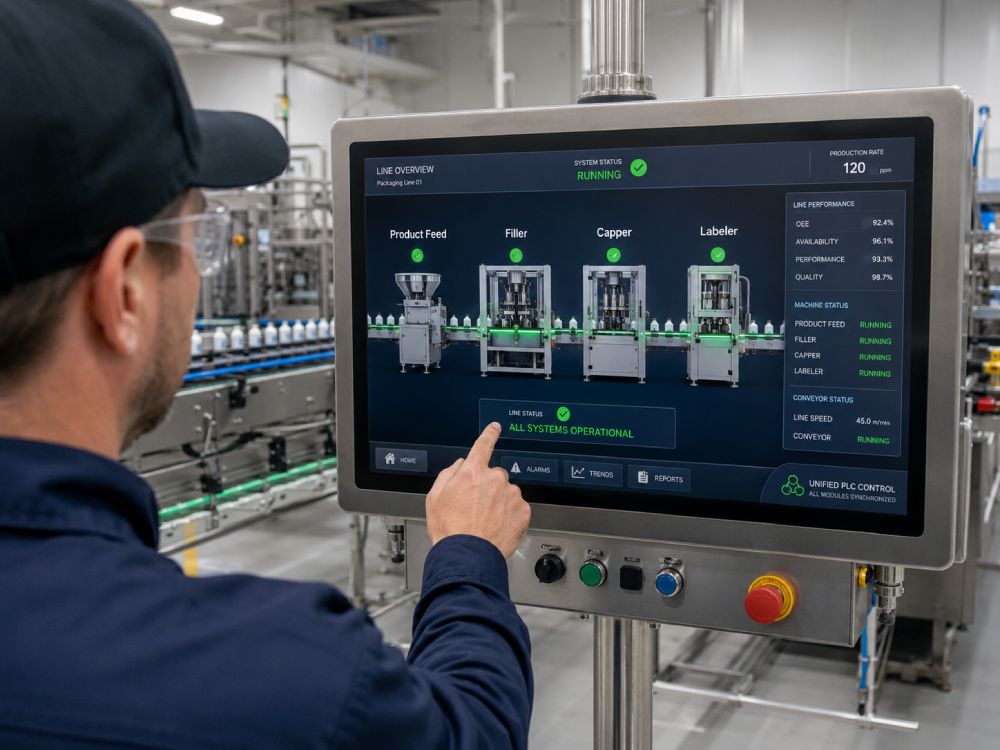
In an efficient pail filling line, each step—product flow, filling speed, container handling, lid placement, lid pressing, labeling, coding, conveying, operator workflow, and more—has to work together in harmony. If one part of the line cannot keep up, the entire process slows down.
Integration is another key factor. The right integration plan can improve accuracy, reduce waste, support safer operation, and create a more reliable path from empty pail to finished product.
In this article, we’ll break down the basics of pail filling line integration, the equipment involved, the decisions that affect performance, and the practical steps manufacturers should take before investing in a new line or upgrading an existing one.
What Is Pail Filling Line Integration?
Pail filling line integration is the process of connecting the equipment, controls, container handling, and operator steps involved in filling and packaging pails. Instead of treating the filler, closer, labeler, conveyor, and controls as separate decisions, integration looks at how the full line works together.
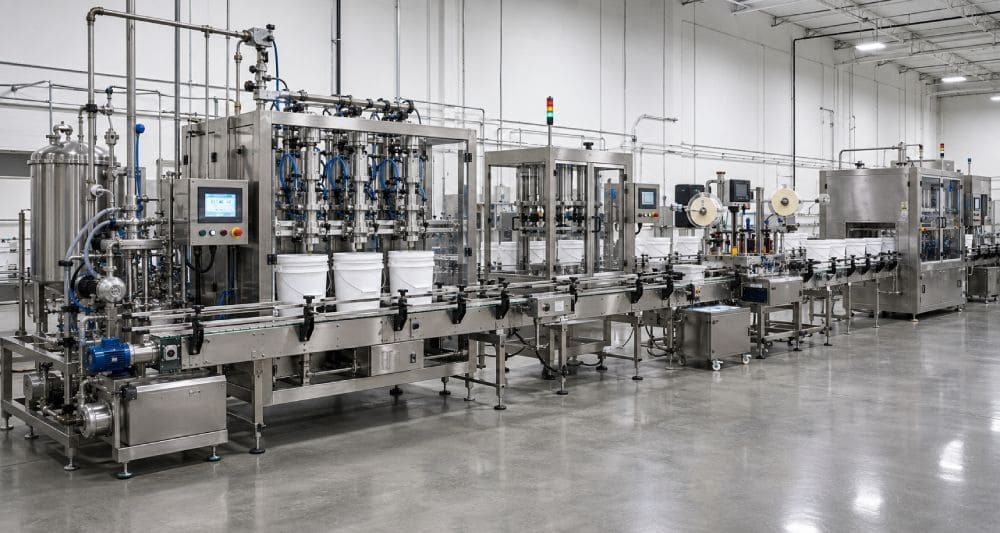
A basic setup may include a semi-automatic pail filler, roller conveyor, manual lid placement, and pail closer. A more advanced line may include product-feed pumps, automatic indexing, multiple filling heads, integrated scales, lid handling, labeling, coding, sensors, and accumulation.
The right setup depends on production volume, product type, container size, available space, labor requirements, and future growth goals. What matters most is flow. If the filler is fast but lid pressing or labeling cannot keep up, the line still slows down.
A strong integration plan evaluates the whole process before equipment is selected.
The Core Parts of a Pail Filling Line
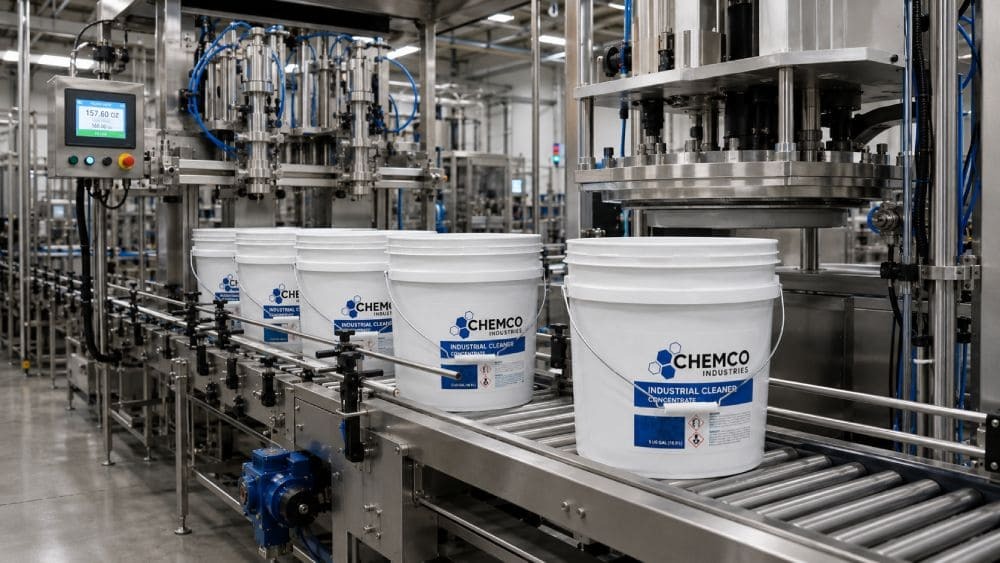
Every pail filling operation is different, but most lines include the same core functions. Each one affects speed, accuracy, safety, and finished-product quality.
Product Feed & Supply
Before filling begins, the product must move from a tank, tote, mixer, or other supply source into the filler. This part of the line has to match the product’s behavior.
Thin liquids, thick coatings, adhesives, sealants, foamy products, abrasive materials, and products with particulates all move differently. Pump selection, hoses, valves, fittings, seals, and product-contact materials should be chosen with those characteristics in mind.
If the product feed is inconsistent, the filler may experience surging, dripping, air pockets, slow fills, or inaccurate weights. Good integration starts before the product reaches the nozzle.
Container Handling & Positioning
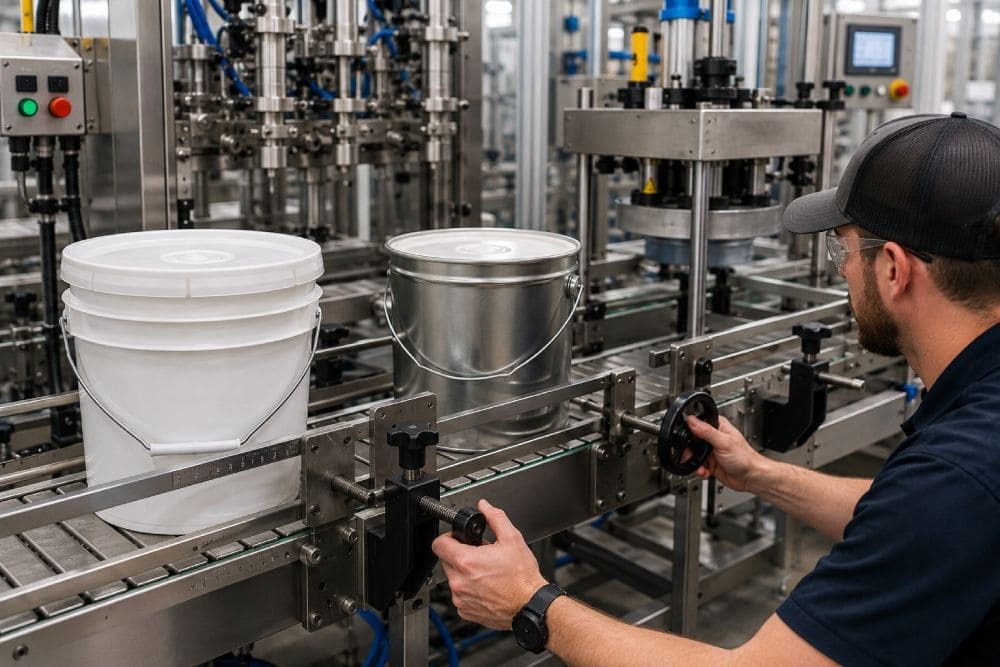
Pails are larger and heavier than many other containers, especially after filling. The line needs a reliable way to stage empty pails, move them into position, hold them steady during filling, and transfer them to the next step. This approach may involve roller conveyors, powered conveyors, guide rails, indexing systems, container stops, or custom handling equipment.
Accurate positioning is important because a misaligned pail can lead to splashing, product loss, poor fill accuracy, or manual correction.
The layout should also reduce unnecessary lifting, reaching, and repositioning. If operators have to fight the line, throughput and safety both suffer.
Filling Equipment
The filler is the center of the line. The right filling system depends on product type, container size, fill volume, accuracy requirements, available space, and operator involvement.
Pail filling may use net-weight filling, volumetric filling, or pump-based filling depending on the application. Net-weight filling is often useful for larger containers or products sold by weight because it fills based on the actual amount of product delivered into the pail.
Features such as load cells, digital controls, recipe storage, fast-fill and slow-fill profiling, positive shut-off nozzles, and no-drip cut-off can improve repeatability and reduce waste. The filler must work with the rest of the line, including product feed, container handling, closing, labeling, and downstream flow.
Lid Placement & Lid Pressing
After filling, the pail has to be closed securely. Lid placement and lid pressing affect leak prevention, product protection, shipping safety, and customer experience. Some operations rely on manual lid placement before the pail moves into a closer. Others use semi-automatic or automated lid handling. The right approach depends on volume, lid style, container type, and labor requirements.
Pail closing should be reviewed during integration because poor lid application can cause leaks, damaged lids, rejected products, and rework. Even if the filler performs well, slow or inconsistent lid pressing can limit the entire line.
Capping, Plugging, & Secondary Closure Steps
Some pail formats include caps, plugs, spouts, vents, tamper-evident features, or other secondary closures. These steps should be included in the line plan when they apply.
Secondary closures may require equipment for cap placement, tightening, torque control, plug insertion, or closure verification. They can also affect container orientation, label placement, and downstream handling.
Even when these steps are manual, they still influence labor planning, line speed, quality control, and finished-goods flow.
Labeling & Product Identification
A filled and closed pail still needs the right label, code, and product information. Labeling supports branding, compliance, inventory control, shipping, and safe product use.
Pail labeling may include front labels, back labels, wraparound labels, top labels, barcode labels, lot codes, hazard labels, regulatory details, and private-label branding. The right setup depends on pail shape, surface texture, handle placement, label size, label material, and required orientation. If labeling is too slow, it becomes the bottleneck. If labels are crooked, wrinkled, unreadable, or applied to the wrong panel, the line creates rework instead of finished product.
Conveying, Accumulation, & Downstream Flow
Conveyors connect each step and help control the pace of the line. In pail filling, they must handle both empty and filled containers safely.
Filled pails are heavy, so conveyor speed, transfer points, rollers, guide rails, spacing, and accumulation areas need to be planned carefully. Poor conveyor design can lead to tipping, collisions, product splash, label damage, or operator congestion.
The line should also account for inspection, checkweighing, palletizing, finished-goods staging, and forklift access. A clear downstream path keeps filled pails from backing up after closing or labeling.
Controls, Sensors, & Operator Interface
Integration is not only mechanical. The controls need to support how the line runs, changes over, and responds to problems.
A pail filling line may include programmable logic controller (PLC) controls, a human-machine interface (HMI), fill set points, recipe storage, conveyor controls, scale feedback, safety interlocks, sensors, alarms, and diagnostic messages. These tools help operators keep the line consistent and make adjustments faster.
Recipe storage is especially useful for facilities that run multiple products or container sizes. Clear controls reduce guesswork, speed up troubleshooting, and make the line easier to operate.
Safety, Sanitation, & Maintenance Access
A pail filling line should be safe, cleanable, and easy to service. Those requirements should be built into the design, not handled after installation.
Safety considerations may include guarding, emergency stops, splash control, pinch-point protection, electrical enclosures, and ergonomic access. Cleanability depends on the product, industry, construction materials, fittings, pumps, nozzles, and product-contact parts.
Maintenance access is also important. If pumps, nozzles, sensors, conveyors, closers, or labelers are hard to reach, routine service takes longer.
A line that is easier to clean and maintain will usually perform better over time.
10 Tips for Successful Pail Filling Line Integration
A successful integration project starts with the right questions. Before purchasing new equipment or upgrading an existing line, manufacturers should review the full operation from product supply to finished-goods handling.
1. Start with the Product, Not the Machine
The product should drive the line design.
Viscosity, foaming, particulates, corrosiveness, abrasiveness, temperature, and settling behavior all affect equipment selection. A thin cleaning solution, a thick adhesive, a solvent-based coating, and a food product with particulates may all require different pumps, nozzles, seals, fittings, and fill profiles.
Choosing a filler before evaluating the product can lead to problems such as dripping, clogging, inaccurate fills, excessive foaming, splash, long cleaning cycles, or premature wear. Product testing helps confirm the right filling method, nozzle style, product path, and speed profile before the system is finalized.
2. Map the Full Workflow
Map the entire process from empty pail to finished product. That map should include empty-container staging, product feed, filling, weighing, lid placement, lid pressing, capping or plugging, labeling, coding, inspection, accumulation, palletizing, and shipping preparation. It should also identify which steps are manual, semi-automatic, or automatic.
This exercise often reveals the real bottleneck. The slowest step determines the effective capacity of the line. Lid placement, label changeover, manual palletizing, or poor container staging may be limiting output more than filling speed.
3. Know Your Containers & Closure Requirements
Ignoring container variation is one of the fastest ways to create avoidable production problems.
Pail size is only one part of the container decision. Manufacturers should also review pail material, shape, wall strength, handle position, opening style, lid type, dimensional variation, and closure requirements. A line that runs one pail size may not automatically handle another. Different containers may require guide-rail adjustments, different filling profiles, alternate nozzles, different lid pressing settings, or additional change parts.
Closure requirements deserve special attention. If the lid must withstand shipping, stacking, chemical exposure, or rough handling, the closing process needs to be consistent. If the container includes plugs, spouts, or caps, those steps must be accounted for in the line design.
4. Choose the Right Filling Method for Accuracy & Throughput
Accuracy and speed must be balanced. A line that fills quickly but creates overfills, underfills, splashing, or rework is not truly efficient.
Net-weight filling can be a strong choice for larger containers, high-value products, or products sold by weight. The system fills based on the actual product weight in the container, which can improve consistency when container tare weights vary. Volumetric or pump-based filling may be a good fit for other applications depending on the product, fill volume, and tolerance requirements.
Fill profiling can also improve results. A fast-fill stage moves product quickly at the beginning of the cycle, while a slow-fill stage helps fine-tune the final amount. This approach can help reduce overfill risk while still supporting productive line speeds.
The right filling method depends on the product, container, required tolerance, production volume, and business goals.
5. Build for Changeover
Many manufacturers fill more than one product or container size on the same line. That makes changeover planning critical because fast, repeatable changeover gives the operation more flexibility and protects uptime.
Recipe storage, repeatable guide-rail settings, easy nozzle adjustment, accessible product paths, clear operator instructions, and no-tool adjustments can all help reduce downtime between runs. Labeling and coding changes should also be included in the changeover plan.
A line designed around one perfect stock keeping unit (SKU) may struggle when real production requires variety. If the business fills multiple products, sizes, or private-label formats, the line should be built for that reality from the beginning.
6. Plan the Layout Around People & Material Flow
Even highly capable equipment can underperform in a poor layout.
Operators need access to empty pails, lids, labels, controls, inspection points, maintenance areas, and finished goods. The layout should reduce unnecessary lifting, walking, reaching, waiting, and rework. It should also account for forklift movement, pallet staging, raw-material access, and maintenance clearance.
A technically correct line can still fail if operators cannot use it comfortably. A good integration plan studies how people, containers, product, packaging materials, and finished goods move through the space.
7. Prioritize Labeling & Coding
A pail is not finished until the right information is on the right container.
Labeling errors can create serious downstream problems. A mislabeled pail may lead to shipping delays, customer complaints, compliance issues, or product returns.
Label placement, code placement, sensor verification, SKU changeover, and label supply should be planned early. The labeling system must fit the container shape, label material, surface condition, orientation needs, and line speed.
If labeling cannot keep up with filling and closing, it becomes the bottleneck. If label changes are not tied into production procedures, operators may be more likely to apply the wrong label to the wrong product.
8. Think About Cleaning, Maintenance, & Spare Parts Before Startup
A line that is hard to clean or service will lose capacity over time. Before startup, review how operators will clean nozzles, pumps, hoses, fittings, conveyors, closers, labelers, and product-contact components. Also review how maintenance teams will access wear items, sensors, belts, seals, gaskets, valves, and electrical components.
Preventive maintenance protects fill accuracy, closure performance, label quality, and uptime. It should not be treated as something to figure out after the line is already running.
A spare-parts strategy should be part of the integration plan. Keeping critical wear parts available can reduce downtime when normal maintenance is needed.
9. Test with Real Products & Containers
Testing is one of the best ways to reduce integration risk.
Whenever possible, test the line with the actual product, actual pails, actual lids, and actual labels. This approach helps reveal issues that may not appear in theory, such as foaming, dripping, splash, label adhesion problems, pail variation, lid fit issues, or operator workflow concerns.
Testing can also help refine fill settings, nozzle height, fill speed, conveyor speed, guide rails, closure pressure, and changeover procedures.
Operators should be included in testing when possible. They often notice practical issues that engineering teams or purchasing teams may miss.
10. Work with a Partner That Understands the Full Line
The best pail filling line integration results come from understanding how each step affects the next. A knowledgeable equipment partner can help evaluate product characteristics, container requirements, filling accuracy, line speed, closure needs, labeling, conveyors, controls, layout, installation, training, and long-term support.
This guidance can prevent expensive mismatches. It can also help manufacturers make smarter decisions about what to automate now, what to keep manual, and how to leave room for future upgrades.
FAQs About Pail Filling Line Integration
What Equipment Is Typically Included in a Pail Filling Line?
A pail filling line may include product-feed equipment, a pail filler, pumps, hoses, nozzles, conveyors or roller beds, lid placement, lid pressing or pail closing, capping or plugging equipment, labelers, coding systems, inspection stations, and downstream handling equipment.
What Is the Difference Between Semi-Automatic & Automatic Pail Filling?
Semi-automatic pail filling requires more operator involvement, while automatic systems use more integrated controls, sensors, conveyors, and indexing to reduce manual handling and coordinate the process.
Is Net-Weight Filling Better for Pails?
Net-weight filling is often a strong option for larger containers, products sold by weight, or applications that need tight fill accuracy, but the best method depends on the product, fill volume, speed, and tolerance requirements.
How Do I Know Whether I Need a Single-Head or Multi-Head Pail Filler?
The choice depends on required throughput, fill volume, container size, product-flow capacity, available floor space, and whether the rest of the line can keep up with a faster filling process.
What Causes Bottlenecks in Pail Filling Lines?
Common bottlenecks in pail filling lines include slow empty-pail staging, inconsistent product feed, poor pail positioning, manual lid placement, slow lid pressing, labeling delays, limited accumulation space, inefficient palletizing, and unclear operator workflow.
Can One Pail Filling Line Handle Multiple Products Or Container Sizes?
Yes, but the line must be designed for changeover, including product compatibility, cleaning requirements, recipe storage, guide-rail adjustments, nozzle setup, lid styles, label changes, and closure requirements.
What Should I Review Before Upgrading an Existing Pail Filling Line?
Review current throughput, fill accuracy, reject rates, downtime, cleaning time, maintenance issues, labor needs, space limits, SKU range, closure performance, labeling accuracy, and future production goals.
How Important Is Product Testing Before Choosing Pail Filling Equipment?
Product testing is important because it helps confirm the right pump, nozzle, fill speed, fill profile, material compatibility, closure approach, and container-handling setup before the line is installed.
Should I Automate the Entire Pail Filling Process at Once?
Not always. The best approach is to solve the biggest bottlenecks first, whether that means upgrading the filler, adding a pail closer, improving conveyors, adding labeling equipment, or redesigning the layout.
Who Can Help Design or Integrate a Pail Filling Line?
Manufacturers should work with a filling and packaging equipment provider that understands product handling, fill accuracy, container movement, closure systems, labeling, controls, installation, training, and long-term support.
Choose Oden Machinery for Trusted, High-Quality Used Liquid Packaging Equipment
The goal of pail filling line integration is to build a complete packaging process that moves efficiently from product supply to filled, closed, labeled, ready-to-ship containers. The best results come from matching the product, container, closure, labeling needs, controls, layout, and operator workflow. When these pieces are planned together, manufacturers can improve accuracy, reduce waste, simplify changeover, support safer operation, and create a stronger foundation for growth.
If you are planning a new pail filling line or upgrading an existing process, Oden Machinery can help.
At Oden Machinery, we specialize in supplying used liquid packaging equipment that meets the highest standards of quality, performance, and reliability. Every machine is thoroughly inspected, refurbished, and supported with expert service to ensure your production line operates smoothly and efficiently.
Whether you’re looking for a single filler or a complete packaging system, we have the equipment and expertise to match your needs.
Contact us today to learn more about our available inventory of used liquid packaging equipment and find the perfect solution for your operation.
