
 716.874.3000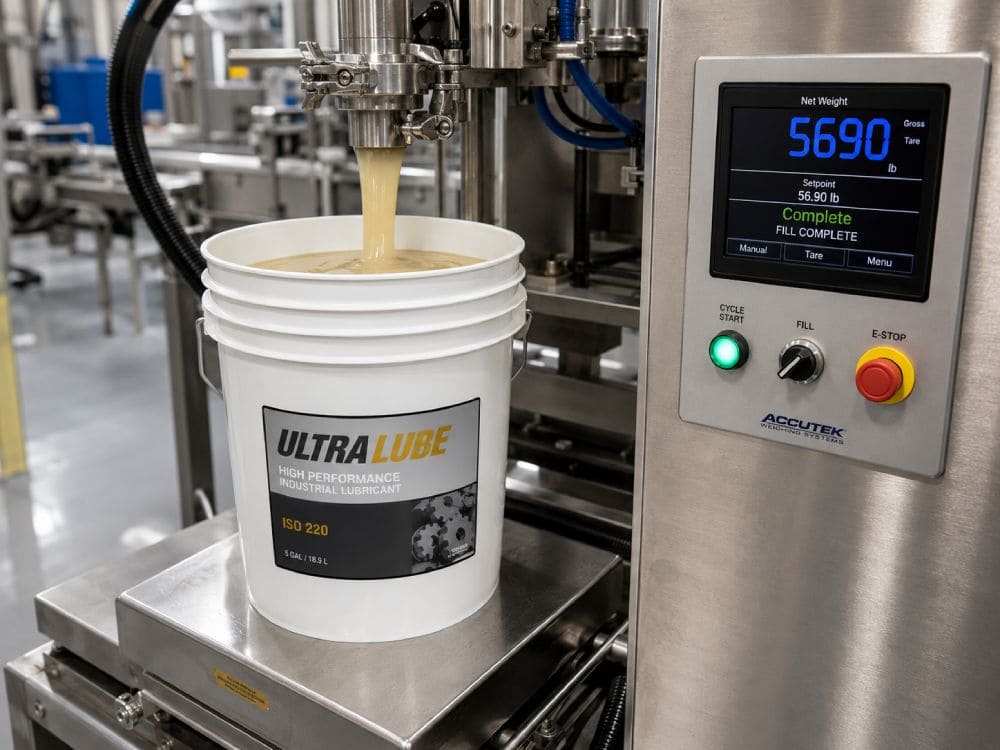
Pail filler throughput refers to how many filled and finished pails a system can complete within a set period of time, usually measured in pails per minute, pails per hour, gallons per minute, or total daily output. Product viscosity, fill volume, container size, number of fill heads, operator workflow, lidding, sealing, and line layout can all affect throughput.
In this article, we’ll compare manual, semi-automatic, and fully automatic pail filler throughput so you can understand where each option fits. We’ll also cover the key factors that influence speed and answer common questions about choosing the right filling setup.
Pail Filler Throughput by Machine Type
Pail fillers are commonly grouped by automation level. Each type offers a different balance of speed, labor, flexibility, accuracy, and investment.
|
Filling Approach |
Best Fit |
Operator Involvement |
Throughput Potential |
Throughput Limits |
When to Upgrade |
|
Manual pail filling |
Low-volume runs, small batches, pilot production, occasional pail filling |
High |
Lowest |
Labor pace, visual judgment, pail handling, spills, lidding, fatigue |
When labor, inconsistency, cleanup, or demand starts limiting production |
|
Semi-automatic pail filling |
Growing production volumes that need better accuracy and repeatability |
Moderate |
Moderate |
Operator loading and unloading, fill rate, pail staging, lidding, pump capacity |
When manual filling is too slow or inconsistent but full automation is not yet necessary |
|
Fully automatic pail filling |
High-volume, repeatable production environments |
Low |
Highest |
Product supply, viscosity, fill volume, number of heads, lidding, sealing, conveyor layout |
When throughput needs, labor reduction, and line consistency justify automation |
Manual Pail Filling Throughput
Manual pail filling is the most labor-intensive approach. An operator typically positions the empty pail, starts and stops product flow, monitors the fill, moves the pail away, places the lid, and handles any final closing or staging.
Because the operator controls so much of the process, manual throughput is limited by human pace as much as machine capacity. Fatigue, container weight, product mess, fill accuracy requirements, and the time needed to handle each pail all affect output.
Manual filling may work well for low-volume production, small batches, test runs, seasonal products, or facilities that only fill a limited number of pails per day. It keeps equipment costs lower, but it does not scale well when demand increases.
The biggest throughput limits with manual pail filling usually include:
- Operator speed and consistency
- Manual pail placement and removal
- Product flow rate
- Visual judgment or manual weighing
- Drips, spills, and cleanup
- Manual lid placement and closing
- Ergonomic strain from moving heavy filled pails
Manual filling also introduces more variation from one operator to another. One person may stop the fill slightly early. Another may overfill. A third may work faster but create more product loss or cleanup. That inconsistency can lower real throughput because it creates rework, wasted product, and quality checks that slow the shift.
Manual filling gives flexibility, but the throughput ceiling arrives quickly. If production is increasing, labor costs are rising, fill weights are inconsistent, or operators spend too much time cleaning spills, the process is likely ready for a more controlled filling system.
Semi-Automatic Pail Filler Throughput
Semi-automatic pail fillers automate the fill cycle while keeping operators involved in container handling. Depending on the setup, the operator may place the pail, start the fill, remove the filled container, place the lid, or move the pail to a closing station.
This type of system can improve throughput because the machine controls more of the filling process. Instead of relying on visual judgment, a semi-automatic filler can dispense based on a programmed volume, weight, or fill profile, which helps reduce overfills, underfills, and messy containers.
Semi-automatic machines are often a practical upgrade when manual filling is too slow, inconsistent, or labor-intensive but full automation is not yet justified. Throughput still depends on the surrounding workflow, including how quickly operators can load and unload pails, how fast the product can be supplied, and how efficiently lids are applied.
Even with automated fill control, several parts of the process can still affect semi-automatic pail filler throughput:
- Operator loading and unloading speed
- Single-head vs. multi-head configuration
- Product viscosity and pump capacity
- Fill volume
- Drip control and nozzle performance
- Lid handling and closing
- Changeover requirements
- Container staging and available floor space
These limits show why the best results come from pairing the filler with a smart operator workflow, reliable product supply, and an organized closing process.
Fully Automatic Pail Filler Throughput
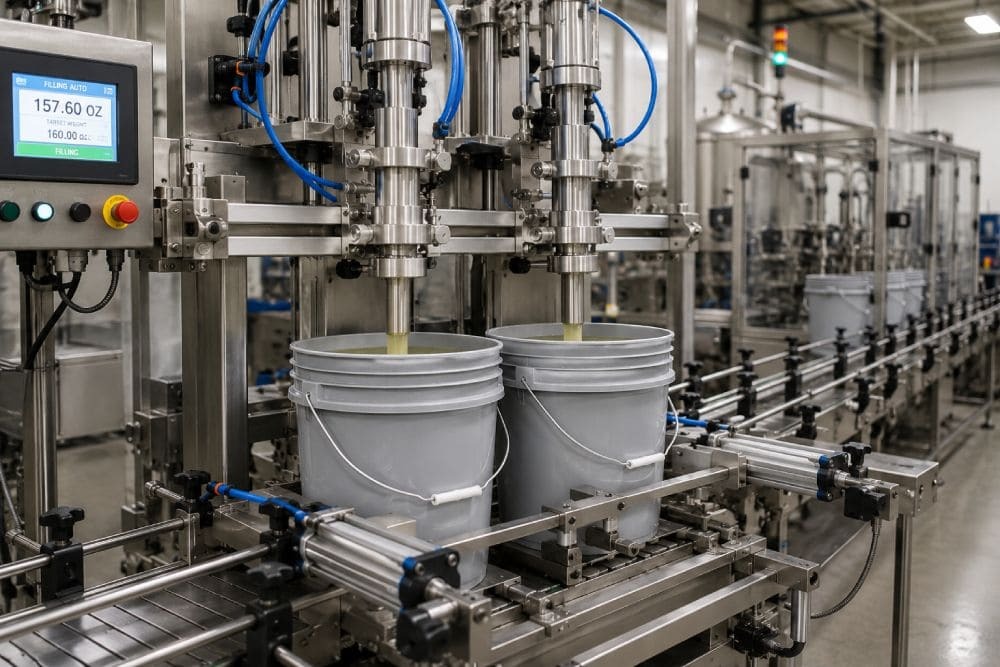
Fully automatic pail fillers are designed for higher-volume production environments. These systems reduce operator involvement by integrating more of the process, such as container handling, indexing, filling, conveying, and downstream line equipment.
A fully automatic system typically offers the highest throughput potential because containers move through a repeatable sequence with less manual handling. It can also help reduce labor dependency, improve consistency, and support longer production runs.
Still, fully automatic does not mean unlimited speed. Pails are large containers, and filling several gallons of product takes time, especially when the liquid is thick, foamy, abrasive, particulated, hot, or sensitive to shear.
A fully automatic filler can only run as fast as the rest of the line allows. Product supply, lidding, sealing, conveyor layout, changeovers, and cleaning can all limit finished output, even when the filler itself performs well.
Common throughput limits with fully automatic pail filling include:
- Product supply and pump sizing
- Number of fill heads
- Fill volume and target accuracy
- Viscosity, foam, splashing, dripping, or particulates
- Container indexing and conveyor layout
- Lid placement and sealing speed
- Labeling, inspection, and palletizing
- Cleaning and changeover time
- Line balance between upstream and downstream equipment
Fully automatic pail filling makes the most sense when production volume is high, demand is repeatable, and the business needs a scalable process with tighter control. It can produce the highest throughput, but only when the complete line is designed around the product, container, and production target.
Key Factors That Affect Pail Filler Throughput
Pail filler throughput is not controlled by one setting or one piece of equipment. A line can only move as quickly as the product, container, filler, operators, and downstream equipment allow. Understanding these factors makes it easier to spot the true bottleneck and choose a filling setup that supports real production goals.
Automation Level
Automation affects how much of the process depends on manual labor. Manual filling relies heavily on operator pace, while semi-automatic filling brings more control to the fill cycle. Fully automatic systems reduce manual touches and help the line run in a more consistent sequence.
More automation is not always the right answer. The best setup is the one that fits the production volume, product mix, labor model, and growth plan.
Liquid Viscosity
Thin, free-flowing liquids usually fill faster than thick products. High-viscosity materials, such as coatings, adhesives, sealants, gels, creams, and heavy oils, often need more controlled product handling.
Viscosity can also change with temperature. A product that flows easily in one environment may slow down in a cooler production area, which can affect output from shift to shift.
Number of Fill Heads or Nozzles
More fill heads can increase throughput when filling is the true bottleneck. A single-head system fills one pail at a time, while a multi-head system can fill multiple containers during the same cycle.
That added capacity only helps if the rest of the line can keep up. Product supply, pail staging, conveyor flow, and lidding all need to support the higher output.
Container Size & Fill Volume
Pail size has a direct impact on fill time. A five-gallon pail takes longer to fill, move, close, and handle than a smaller container.
Larger filled pails also create more material-handling demands. Conveyors, roller beds, staging areas, and closing equipment need to be built for the container weight and workflow.
Throughput should always be evaluated around the actual pail size and fill volume, not a generic machine rating.
Mechanical Setup & Changeover
Fast run speed only makes a difference when the machine is available to run. If a facility fills multiple products or pail sizes, setup and changeover time can reduce total daily output.
Repeatable adjustments, saved recipes, accessible controls, and tool-less changeover features can help reduce downtime. A machine that is easier to set up often produces more across a full week, even if its peak speed is similar to another system.
Product Foaming, Splashing, & Dripping
Some products cannot be filled at maximum speed without creating foam, splashes, or drips. When that happens, the line may need slower filling, staged filling, bottom-up filling, or better nozzle control.
Clean filling is key. A slightly slower cycle can produce more saleable pails if it reduces cleanup, rejects, product loss, and label contamination.
Lidding & Sealing
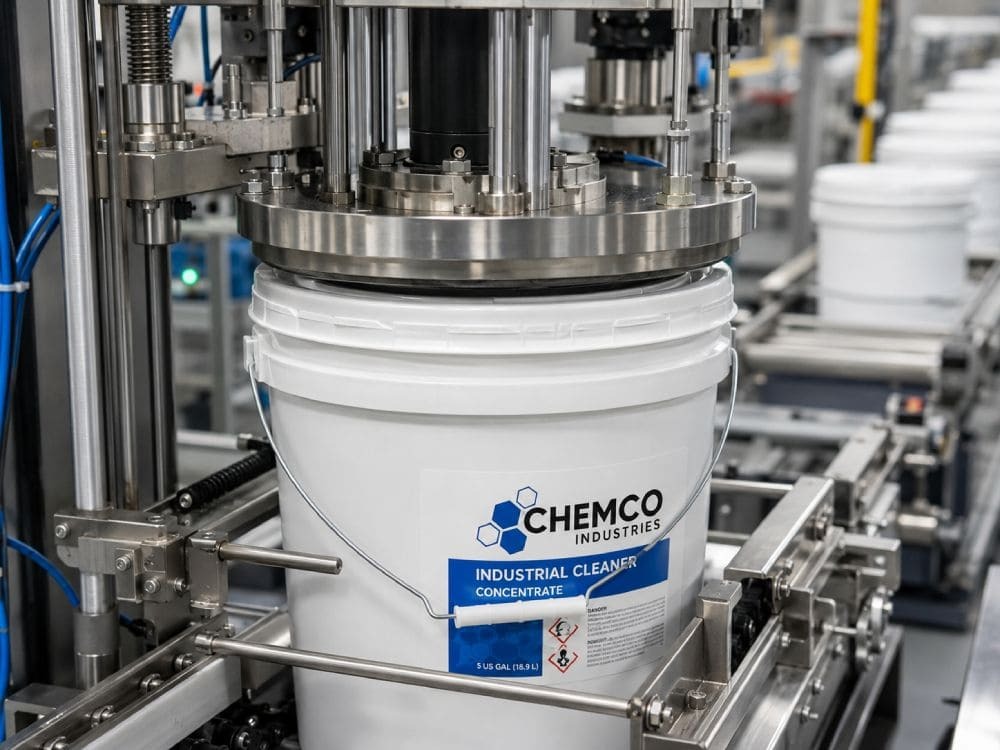
Lidding is often where pail filling lines slow down. A filler may complete the fill quickly, but finished throughput drops if lids are placed or sealed too slowly. It’s especially true with larger, heavier containers. Lid alignment, closing force, seal checks, and container movement all take time. For better output, the closing process should be evaluated with the filler, not after it.
Pump Type & Product Delivery
The pump controls how quickly product reaches the container. It also needs to match the liquid’s viscosity, particulates, abrasiveness, chemical profile, sanitary requirements, or shear sensitivity. An undersized pump can hold back the entire line. So can poor product feed, restrictive piping, or a supply tank that cannot keep the filler properly supplied.
Filling Method (Volumetric vs. Net Weight)
Volumetric filling dispenses a measured amount of product by volume. Net weight filling fills the container to a target weight, which is often useful for larger containers or products sold by weight.
The best method depends on the product, container, accuracy target, and customer requirements. Speed is important, but not if it creates product giveaway, inconsistent fills, or avoidable rework.
Operator Skill & Labor Availability
Operators still influence throughput, even with automation. They stage containers, load lids, monitor the machine, manage changeovers, and respond when the line stops.
In manual and semi-automatic systems, workflow matters even more. A clean station, clear settings, and well-trained operators can make a noticeable difference in finished pails per hour.
Labor availability should also shape the equipment decision. If staffing is inconsistent, automation can help reduce the line’s dependence on individual operator speed.
Downstream Handling & Line Balance
A filler cannot outrun the rest of the packaging line for long. Lid placement, sealing, labeling, inspection, coding, accumulation, and palletizing can all become the limiting step.
Line balance is especially important for fully automatic systems. Every piece of equipment needs to work at a compatible pace, or the line will stop, back up, or need constant operator intervention.
Cleaning, Sanitation, & Product Changeovers
Cleaning time reduces available production time. Sticky, pigmented, hazardous, corrosive, sanitary, or allergen-sensitive products may require more involved cleanup between runs.
For facilities with frequent product changes, easier access and efficient cleaning can have a major effect on weekly throughput. Peak speed matters less when the line spends too much time out of production.
When Should You Upgrade Your Pail Filling Process?
It may be time to upgrade your pail filling process if:
- Operators can’t keep pace with demand
- Fill weights vary too much from pail to pail
- Product giveaway is increasing costs
- Spills, drips, or cleanup are slowing production
- Heavy pail handling is creating ergonomic concerns
- Lidding and sealing are creating backups
- Changeovers take too long
- Production has become more predictable
- Customers require tighter consistency
- Labor constraints are limiting growth
The right upgrade is not always the most automated option. In some cases, the best improvement may be a better pump, a cleaner nozzle setup, an improved pail closer, or a more balanced conveyor layout. The goal is to produce more accurate, clean, closed, saleable pails with less waste and less strain on the production team.
FAQs About Pail Filler Throughput
How Many Pails per Hour Can a Pail Filler Produce?
Throughput depends on fill volume, liquid viscosity, machine configuration, number of fill heads, pump capacity, operator involvement, and downstream closing. The most useful estimate should be based on the actual product, container size, target fill amount, and full packaging workflow.
What Is the Difference Between Manual & Semi-Automatic Pail Filling?
Manual pail filling depends heavily on the operator to control the fill, monitor the container, and move the pail through the process. Semi-automatic pail filling automates more of the fill cycle, which can improve accuracy, consistency, and repeatability. Operators may still place and remove pails, but the machine controls more of the filling work.
Is a Fully Automatic Pail Filler Always the Fastest Option?
A fully automatic pail filler usually has the highest throughput potential, but it’s only as fast as the full line allows. Product supply, viscosity, fill volume, lidding, sealing, conveying, and downstream handling all affect finished output. If the line is not balanced, the bottleneck may simply move from the filler to another part of the process.
Does Viscosity Affect Pail Filler Throughput?
Yes, viscosity can have a major impact on pail filler throughput. Thicker liquids usually move more slowly through pumps, hoses, and nozzles than thin liquids. High-viscosity products may need specialized pumps, larger product pathways, slower fill profiles, or additional drip control.
Does Adding More Fill Heads Increase Throughput?
Adding fill heads can increase throughput when filling is the bottleneck and the rest of the line can support the added output. The product supply system, conveyors, operators, lidding process, and downstream equipment must all keep pace. If another part of the line is already limiting output, more fill heads may not create the expected improvement.
What Type of Pail Filler Is Best for Five-Gallon Containers?
The best pail filler for five-gallon containers depends on production volume, product characteristics, accuracy requirements, labor availability, and closing needs. Manual filling may work for very low-volume operations, while semi-automatic filling may be a strong fit for moderate production that needs better consistency. Fully automatic filling may be the right choice when high-volume production, repeatability, and labor efficiency are priorities.
Why Is Lidding Important When Calculating Pail Filler Throughput?
Lidding is important because a filled pail is not finished until it is properly closed. If lids are applied or sealed too slowly, the line can back up even when the filler itself is running well.
Should Pail Filling Be Based on Volume or Weight?
Both volumetric and net weight filling can be appropriate, depending on the product and application. Volumetric filling dispenses a measured amount of product by volume, while net weight filling fills to a target weight. The right choice depends on the product, container, accuracy target, and customer or regulatory expectations.
How Can I Improve Pail Filling Throughput Without Buying a New Machine?
Start by finding the actual bottleneck in the process. Review product supply, pump sizing, nozzle setup, operator workflow, pail staging, lidding, sealing, cleaning time, and line layout. Sometimes the filler is not the problem; a slow closing process, poor staging area, undersized pump, or inefficient changeover may be reducing output more than the filler itself.
How Do I Know If I Need a Semi-Automatic or Fully Automatic Pail Filler?
Look at production volume, labor availability, product consistency, changeover frequency, available space, and growth expectations. Semi-automatic systems are often a good fit when manual filling is too slow or inconsistent but the operation still benefits from operator flexibility. Fully automatic systems are better suited for higher-volume, repeatable production where labor reduction, speed, and consistency justify the investment.
Choose Oden Machinery for Trusted, High-Quality Used Liquid Packaging Equipment
If your current pail filling process is too slow, inconsistent, or labor-intensive, we’re here to help.
At Oden Machinery, we specialize in supplying used liquid packaging equipment that meets the highest standards of quality, performance, and reliability. Every machine is thoroughly inspected, refurbished, and supported with expert service to ensure your production line operates smoothly and efficiently.
Whether you’re looking for a single filler or a complete packaging system, we have the equipment and expertise to match your needs.
Contact us today to learn more about our available inventory of used liquid packaging equipment and find the perfect solution for your operation.
