 716.874.3000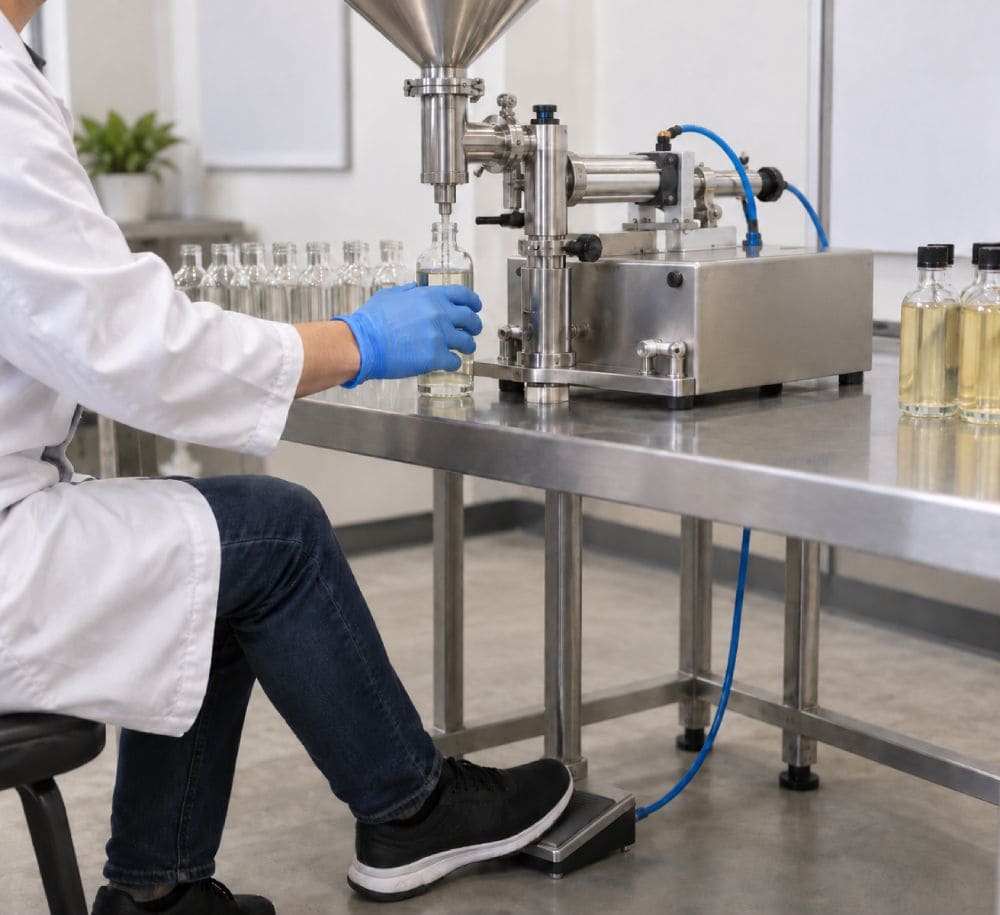
The choice between manual and automatic liquid filling equipment is not always obvious. Manual systems are accessible and flexible. Automatic systems offer speed and consistency. And somewhere in between, semi-automatic machines offer a middle path that fits a lot of growing operations better than either extreme.
This guide breaks down how each type of filling machine works, where each one fits, how they compare across the factors that matter most, and how to decide which is right for a specific operation.
In this guide:
- Manual Liquid Filling Machines
- Automatic & Semi-Automatic Liquid Filling Machines
- Manual vs. Automatic Liquid Filling Machines
- How to Choose the Right Filling Machine for Your Operation
- FAQs
Manual Liquid Filling Machines
Manual filling machines are the starting point for most small-batch liquid packaging operations. They are simple, low-cost, and easy to operate without specialized training. For the right operation, they are exactly the right choice.
What Is a Manual Filling Machine?
A manual liquid filling machine is a piece of equipment where the operator controls most or all of the fill cycle by hand. The operator positions the container, activates the fill, monitors the amount dispensed, and stops the flow when the target is reached. Some machines use a foot pedal or lever to trigger the fill. Others use a simple valve or gravity-fed system.
Manual fillers range from basic tabletop gravity fillers to more refined benchtop systems with adjustable fill stops and nozzle controls. What they share is that the operator is the primary control mechanism.
Features & Benefits of Manual Filling Machines
Manual filling equipment offers several advantages that make it a practical starting point for small businesses and growing brands:
- Low capital cost: Manual fillers are among the most affordable filling solutions available, making them accessible for startups and low-volume operations.
- Simple setup and operation: Most manual systems require minimal installation, no complex programming, and little operator training.
- Fast changeover: Switching between products or container sizes typically involves a quick rinse and a nozzle adjustment, not a full recipe change.
- Flexibility: Manual fillers handle a wide range of products and container formats without requiring custom tooling or configuration.
- Minimal infrastructure: Most benchtop and tabletop manual fillers run on standard power and require no compressed air or additional utilities.
Common Applications for Manual Filling Machines
Manual filling machines are well-suited for:
- Startups and early-stage operations filling low daily volumes
- Pilot runs and product development where fill parameters are still being tested
- Specialty or artisan products with small batch sizes and high product variety
- Operations filling a wide range of products in small quantities where flexibility matters more than speed
- Facilities where floor space is limited and a tabletop solution is the only practical option
Where Manual Filling Reaches Its Limits
Manual filling works well until volume increases, fill accuracy requirements tighten, or labor costs become disproportionate to output. Because the operator controls the fill, throughput is tied directly to human pace, and fill accuracy depends on the operator's attention and consistency. Fatigue, shift changes, and varying technique all introduce variability that compounds as volume grows.
Automatic & Semi-Automatic Liquid Filling Machines
As production volume grows and fill accuracy requirements tighten, most operations move toward more automated filling solutions. That transition does not always mean jumping straight to a fully automatic line. Semi-automatic filling machines are a practical middle ground that fit a wide range of growing operations.
What Is a Semi-Automatic Filling Machine?
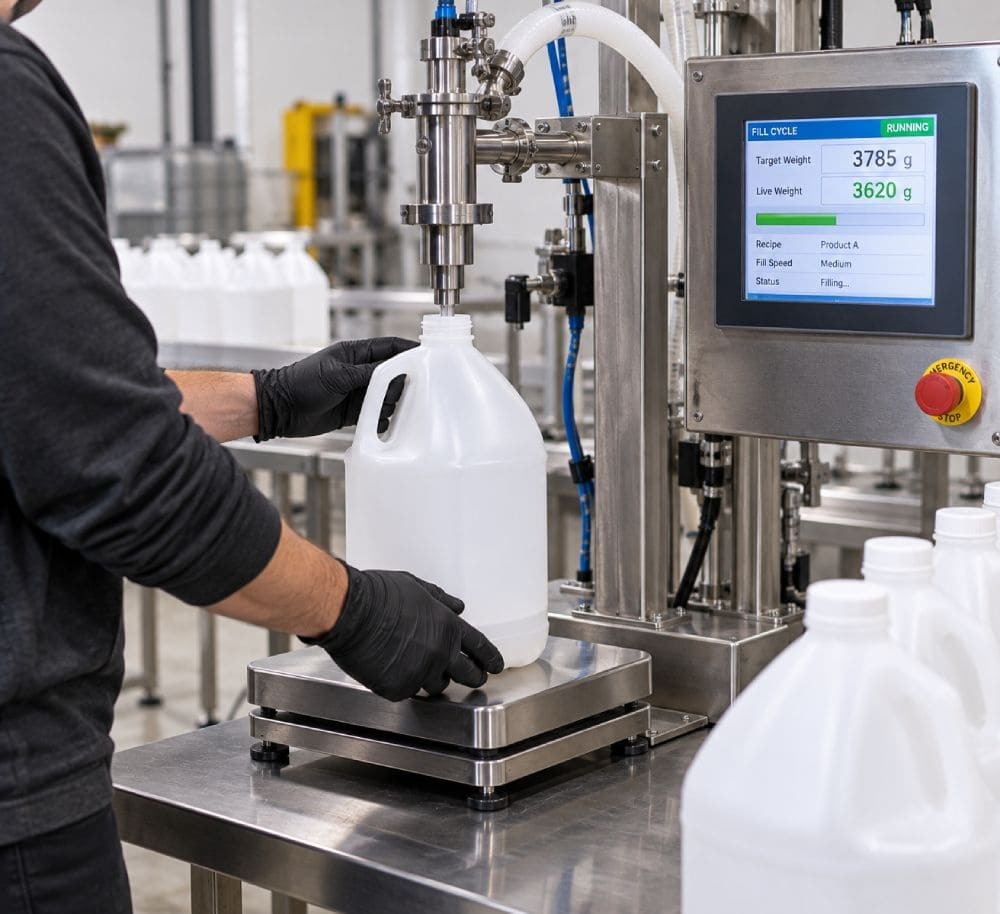
A semi-automatic filling machine automates the fill cycle itself while keeping the operator involved in container handling. The operator places the empty container, initiates the fill, and removes the filled container when the cycle is complete. The machine controls how much product is dispensed, how the fill profile runs, and when the nozzle cuts off.
This division of labor is what makes semi-automatic equipment valuable. The machine handles the part of the process where consistency matters most. The operator handles the physical steps that still require human involvement. The result is meaningfully better accuracy and throughput than a manual system, without the full capital investment of a completely automated line.
What Is a Fully Automatic Filling Machine?
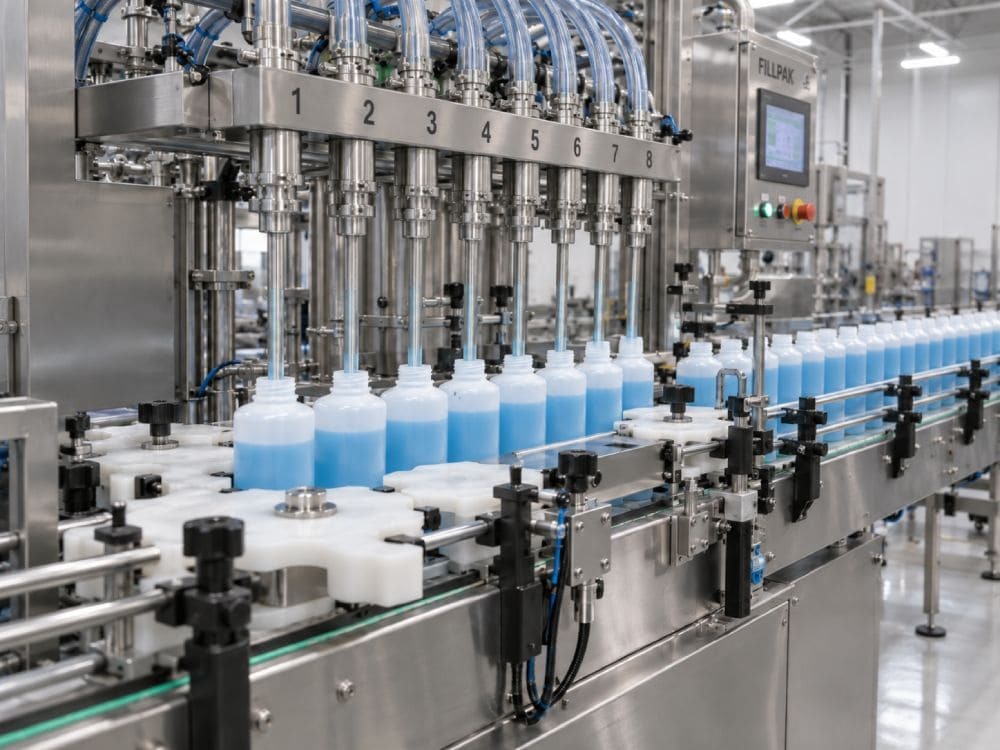
A fully automatic filling machine handles container movement, filling, and downstream steps like capping and labeling with minimal operator involvement. Containers are fed into the system, moved through the fill station, filled to a programmed target, and transferred downstream in a continuous or indexed sequence.
Fully automatic systems are designed for higher-volume, repeatable production environments where consistent output, labor efficiency, and line speed are the priorities. They typically require more infrastructure, more floor space, and a higher capital investment than manual or semi-automatic equipment, but they deliver the highest throughput potential of the three options.
Features & Benefits of Automatic Filling Machines
Automatic and semi-automatic filling equipment offers advantages that become increasingly important as production scales:
- Programmed fill control: Fill accuracy does not depend on operator judgment. The machine controls the cut-off based on weight, volume, or a timed profile.
- Consistent output across operators and shifts: Results are repeatable regardless of who is running the machine or how long the shift has been running.
- Higher sustainable throughput: Because the machine controls the fill cycle, output is not limited by operator pace or fatigue.
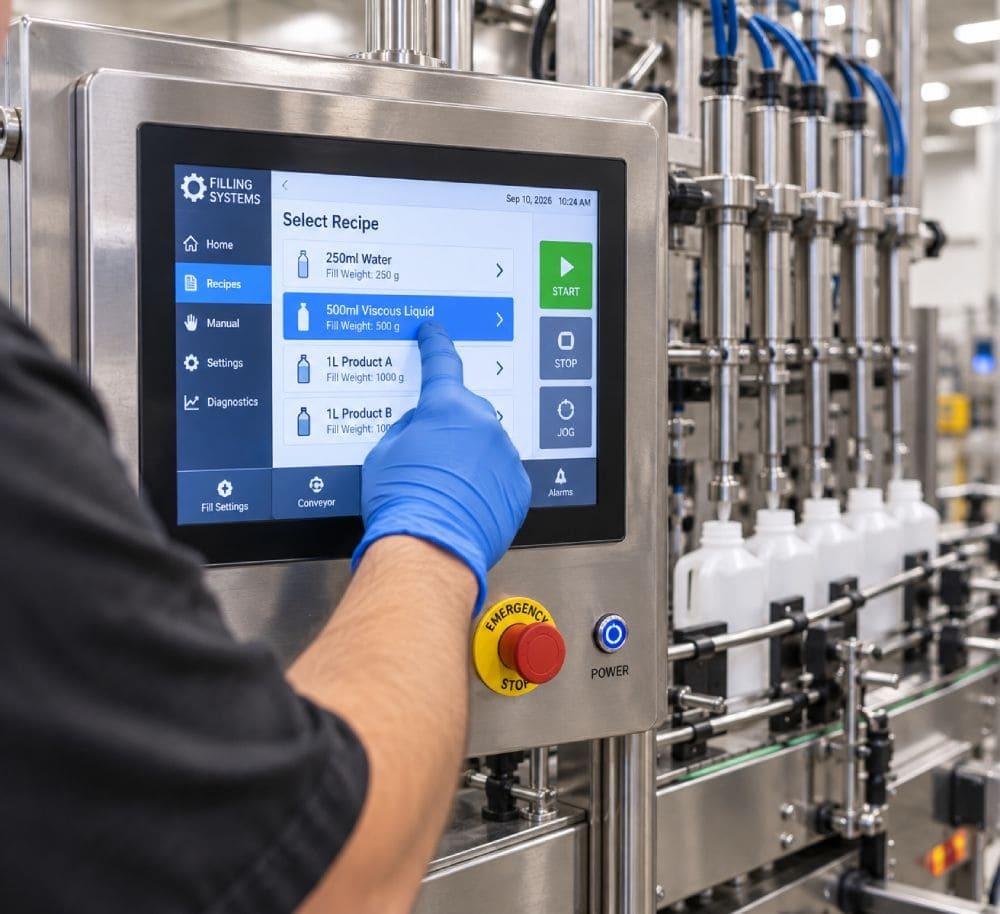
- Recipe storage: Operations running multiple products or container sizes can store fill settings and recall them instantly, reducing setup time and re-dialing errors.
- Scalability: Many semi-automatic systems can be paired with conveyors, closing equipment, and additional fill heads as volume grows. For a closer look at how semi-automatic systems compare to fully automatic lines, see our guide on automatic vs. semi-automatic filling machines.
Common Applications for Automatic Filling Machines
Automatic and semi-automatic filling machines are a strong fit for:
- Operations filling hundreds to thousands of containers per shift on a regular basis
- Products where fill accuracy is critical due to product value, compliance requirements, or customer specifications
- Facilities running the same products and containers repeatedly, where recipe storage reduces changeover time
- Growing brands that need a filling process that can scale without rebuilding the line from scratch
- Operations where labor cost at the filler has become disproportionate to output
Manual vs. Automatic Liquid Filling Machines: Key Differences
The differences between manual and automatic filling machines are not just about speed. They affect fill accuracy, labor requirements, product giveaway, changeover time, and how well the equipment supports the operation as it grows.
The most important distinction is where control over the fill cycle sits. In a manual system, the operator controls the fill. In a semi-automatic or automatic system, the machine controls the fill. That shift changes almost everything downstream: accuracy, consistency, throughput, labor dependency, and the ability to document results.
A manual bottling line gives the operator full flexibility but introduces human variability into every container. An automatic or semi-automatic system removes that variability by replacing judgment with programmed parameters. For operations where fill accuracy, throughput, or labor cost have become constraints, that trade-off is usually worth making.
Side-by-Side Comparison
|
Factor |
Manual |
Semi-Automatic |
Fully Automatic |
|
Fill control |
Operator-controlled |
Machine-controlled |
Machine-controlled |
|
Fill accuracy |
Variable; operator-dependent |
Consistent; repeatable |
Highly consistent |
|
Throughput |
Lowest |
Moderate to high |
Highest |
|
Operator involvement |
High |
Moderate |
Low |
|
Capital cost |
Lowest |
Moderate |
Highest |
|
Infrastructure needed |
Minimal |
Small footprint |
Larger footprint, utilities |
|
Changeover |
Fastest |
Fast with recipe storage |
Moderate |
|
Scalability |
Limited |
Good |
Best |
|
Best fit |
Startup, pilot, low volume |
Growing operations |
High-volume, repeatable runs |
|
Labor cost per unit |
Highest |
Moderate |
Lowest |
|
Product giveaway risk |
Higher |
Lower |
Lowest |
The Role of the Conveyor System
One of the clearest differences between a manual bottling line and an automatic system is the role of the conveyor. Manual operations typically rely on the operator to move containers between stations by hand. Automatic systems use integrated conveyors to move containers through the fill station in a controlled, continuous sequence.
A conveyor-integrated automatic line reduces manual handling, improves container positioning consistency, and allows the line to run at speeds no manual process can match. It also introduces more complexity: conveyor speed, container spacing, and line balance between the filler and downstream equipment all need to be managed.
How to Choose the Right Filling Machine for Your Operation
The right filling machine is not the most advanced one available. It is the one that fits where the operation actually is and where it is headed. The following factors are the most useful starting points for making that decision.
Production Volume & Daily Output Targets
Volume is the clearest indicator of which equipment type makes sense. Manual filling is practical when daily output is measured in dozens to low hundreds of containers. Semi-automatic filling becomes the better fit when output consistently exceeds 300 to 500 containers per shift and the operation needs results that do not vary with the operator. Fully automatic systems make the most sense when volume is high, runs are repeatable, and labor reduction is a priority.
What to ask: How many containers does the operation need to fill per shift today, and what does that number look like in 12 to 18 months? Buying equipment sized only for current demand often means replacing it sooner than expected.
Fill Accuracy Requirements
If the product is high-value, if customers or regulators require documented fill accuracy, or if product giveaway from overfilling is a measurable cost, fill accuracy should drive the equipment decision as much as volume. Manual systems can deliver reasonable consistency under ideal conditions, but they cannot sustain tight tolerances across a full shift, across multiple operators, or as volume increases.
What to ask: What is the acceptable fill variation, and what does overfilling cost per container? For most operations, the answer makes a strong case for moving to a machine-controlled fill system earlier than volume alone would suggest.
Labor Cost & Availability
A manual filling operation requires a dedicated operator for every container filled. As volume increases, that labor cost compounds. A semi-automatic filler still requires an operator to load and unload containers, but the machine controls the fill, which means the same operator can sustain higher output with less physical effort. A fully automatic system reduces operator dependency further.
What to ask: What does it cost to staff the filler for a full shift, and how does that compare to the cost of equipment that could handle the same output with less direct labor involvement?
When to Upgrade from Manual to Semi-Automatic
The decision to move from manual to semi-automatic filling is one of the most common transitions in a growing liquid packaging operation. The clearest signals that it is time to make that move include:
- Fill weights are inconsistent from container to container and the variation is affecting cost or quality
- Operators are spending the majority of the shift at the filler with little time for other tasks
- Production is falling short of demand despite the filler running all shift
- A new customer or contract requires tighter fill accuracy than the current process can reliably deliver
- Product giveaway from overfilling has become a measurable cost
For a detailed breakdown of how to evaluate this transition, including volume thresholds and product-specific considerations, see our guide on benchtop vs. semi-automatic filling machines.
When to Move to a Fully Automatic System
Fully automatic filling makes the most sense when production volume is high, runs are consistent and repeatable, and the operation needs to reduce its dependence on operator availability. If the same product fills the same container day after day and the line needs to run at speeds no semi-automatic system can sustain, a fully automatic configuration is the right investment.
The key question is whether the rest of the line can support the throughput a fully automatic filler can produce. A filler that outpaces everything around it does not improve overall output. It just moves the bottleneck.
Manual vs. Automatic Liquid Filling Machines: FAQs
What Is the Difference Between Manual and Automatic Liquid Filling Machines?
Manual filling machines rely on the operator to control most of the fill cycle, while automatic systems control the fill with programmed settings. Manual equipment is simpler and lower cost. Automatic equipment delivers higher speed, consistency, and scalability.
What Is the Best Liquid Bottle Filler Machine for a Small Business?
The best liquid bottle filler machine depends on volume, product type, and growth plans. For very low output, manual or benchtop filling may be enough. For growing businesses that need better accuracy and throughput, a semi-automatic system is often the strongest fit.
When Should a Company Move from Manual to Automatic Filling?
A company should start looking at automation when fill accuracy becomes inconsistent, labor is tied up at the filler, or demand starts outpacing output. If the line is running all day and still falling behind, the current setup is probably limiting growth.
Does an Automatic Filling Line Require a Conveyor System?
Usually, yes. An industrial conveyor system helps move containers through the line in a controlled sequence. Manual bottling lines rely more on operator handling, which is fine at low volume but becomes a bottleneck as production grows.
Is Semi-Automatic Filling a Good Middle Option?
Yes. Semi-automatic filling is often the best bridge between manual and fully automatic equipment. It gives the operation better accuracy and repeatability without requiring the full investment or footprint of a complete automated line.
How Do I Know Which Filling Machine Is Right for My Product?
Start with the product's viscosity, fill volume, and sensitivity to overfill or waste. Then weigh labor availability, production targets, and how fast you expect to grow. The right machine is the one that fits today without boxing you in tomorrow.
Find the Right Filling Equipment for Your Operation
The decision between manual and automatic liquid filling equipment is about which machine fits the actual production environment, the product being filled, and where the operation is headed.
Manual filling is the right starting point for many small businesses. Semi-automatic filling is where most growing operations land as volume increases and fill accuracy becomes more important. Fully automatic systems make sense when volume, labor efficiency, and line consistency justify the investment.
The key is making that decision based on a clear understanding of the options, not just the equipment cost or the machine that happens to be available.
At Oden Machinery, we work with manufacturers at every stage of growth to find filling equipment that fits their product, their container, and where their operation is headed. Whether the need is an upgrade from a manual system or a fully automated filling line, we have the equipment and the expertise to match the need.
Contact us today to talk through your filling requirements and find the right solution for your operation.
