

 716.874.3000
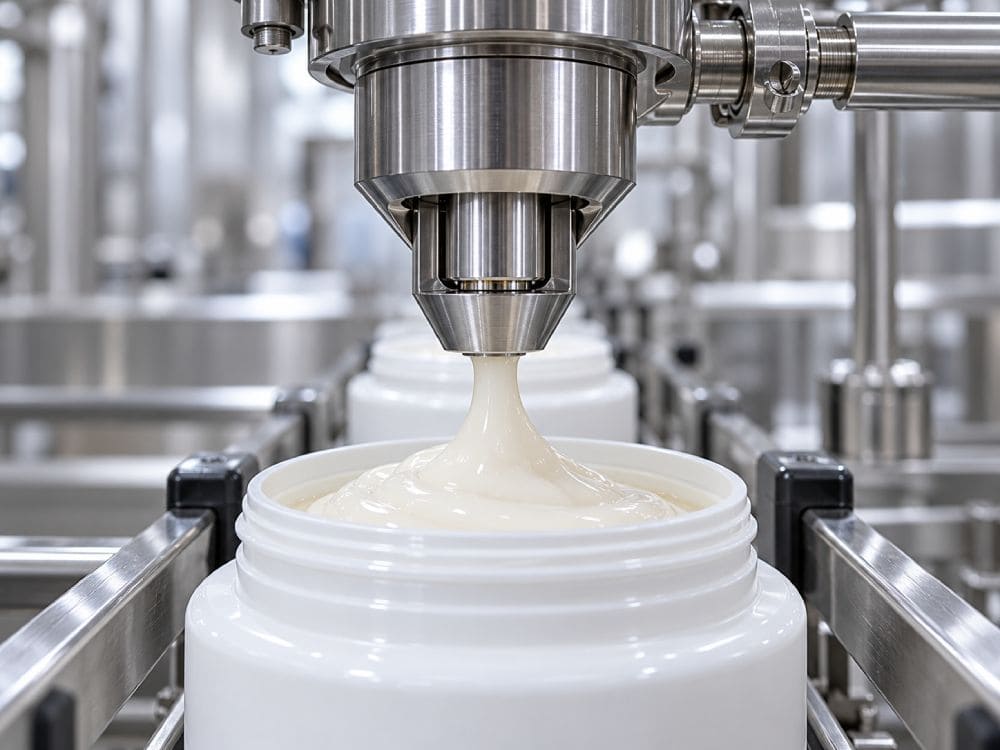
Filling accuracy is easy to maintain when every run looks the same. One product, one container, stable conditions, and the machine does what it was set up to do. The challenge is that most operations do not stay that way for long.
As product lines grow, formulations change, and the same filling equipment gets asked to handle a wider range of products than it was originally dialed in for. A machine running a thin, water-like solvent one day may be asked to fill a thick, particulate-heavy lotion the next. Without understanding how those differences affect fill performance, accuracy problems are almost inevitable.
This guide explains the four main formulation variables that affect filling accuracy, why each one creates problems, and what to do about them.
In this guide:
- How Viscosity Affects Filling Accuracy
- How Temperature Affects Fill Consistency
- How Particulates & Solids Affect Fill Performance
- How Formulation Changes Affect Your Filling Machine
- FAQs
How Viscosity Affects Filling Accuracy
Viscosity is the single biggest variable in liquid filling accuracy. It determines how fast a product moves through the pump, how completely it clears the nozzle, and how predictably it behaves from one container to the next. Get the viscosity match wrong and fill weights will drift, dripping will become a problem, and calibration will feel like a moving target.
Understanding where your product falls on the viscosity spectrum is the starting point for every other decision about pump type, nozzle selection, and fill speed.
High-Viscosity Products
Thick products resist flow. When a filling system is not sized or configured for a high-viscosity product, the pump has to work harder to move the same volume, and the product may not fully clear the nozzle before the fill cycle ends.
What you will see in production: Underfills on the first few containers of a run as the pump builds pressure, inconsistent fill weights across a batch, and product stringing or dripping at the nozzle after the fill head closes.
What to do about it: Thick products generally require a pump type designed for high-viscosity applications, such as a gear pump or a piston pump, along with a nozzle that allows the product to flow cleanly without stringing. Slowing the fill speed and using a fill profile that ramps up at the start and cuts off cleanly at the end can also improve consistency. If the equipment was originally calibrated for a thinner product, recalibration is necessary before running a thicker formulation.
Low-Viscosity Products
Thin, free-flowing liquids move fast and are harder to control at the nozzle. The challenge is not getting the product out. It is stopping it precisely.
What you will see in production: Overfills caused by product continuing to flow after the fill cycle ends, dripping between containers, and foam buildup in containers filled at high speed.
What to do about it: Low-viscosity products require tight nozzle shutoff, often with an anti-drip feature or a dive nozzle that fills from the bottom up to reduce splashing and foam. Fill speed and timing need to be dialed in precisely, and the fill system should be recalibrated any time the product changes, even if the new formulation looks similar to the previous one.
Matching the Pump Type to the Viscosity Range
No single pump type handles the full viscosity spectrum well. Using the wrong pump for the product's viscosity range is one of the most common sources of persistent fill accuracy problems.
What you will see in production: Accuracy problems that persist despite repeated recalibration. The machine is not the issue. The pump type is not suited to the product's flow characteristics, and no amount of adjustment will fully compensate for that mismatch.
What to do about it: Match the pump type to the viscosity range of the product before anything else. If the pump type is wrong for the product, accuracy problems will continue regardless of how carefully the machine is calibrated.
How Temperature Affects Fill Consistency
Temperature and viscosity are closely connected. Most liquid products become thinner as temperature rises and thicker as it drops. That means a product's fill behavior on a cool morning is not the same as its fill behavior by mid-afternoon, and a machine calibrated at the start of a shift may be running out of spec by the time conditions have warmed up.
This is one of the most commonly overlooked sources of fill drift. The machine has not changed. The settings have not changed. But the product has, and the fills are showing it.
Temperature Variation Within a Single Run
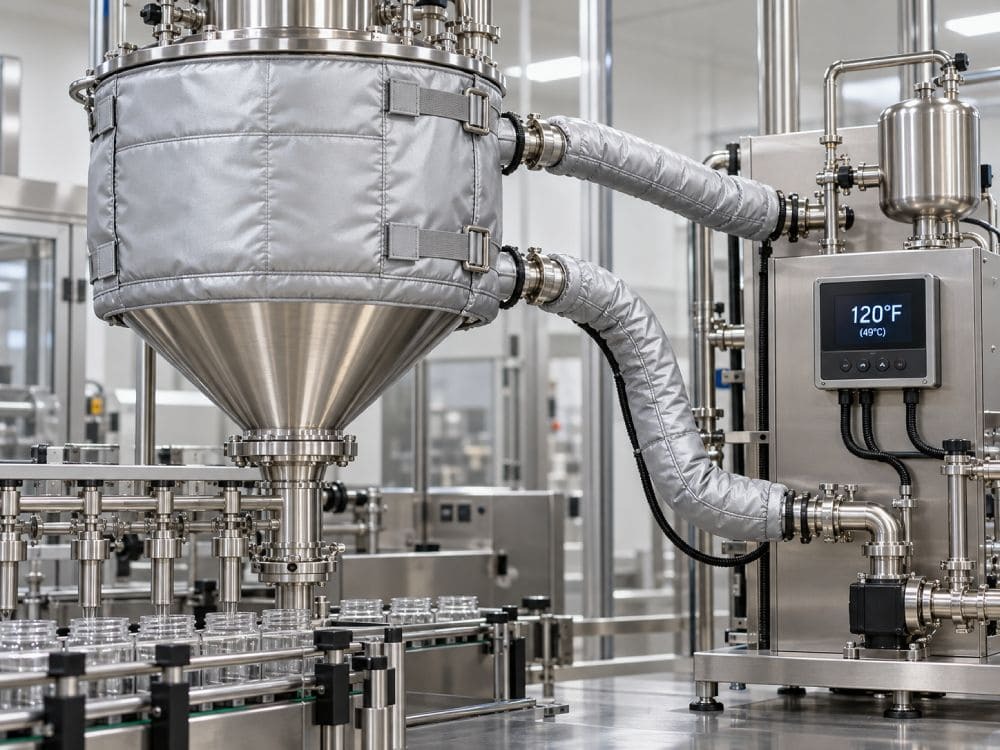
Even when ambient conditions are stable, product temperature can shift during a run. A product sitting in a supply tank at room temperature will behave differently from the same product that has been recirculating through a pump for two hours. Heat generated by the pump itself can raise product temperature enough to measurably affect flow rate and, by extension, fill volume.
What you will see in production: Fill weights that are consistent at the start of a run and gradually drift as the run continues. The shift is often gradual enough that it goes unnoticed until a check-weight or end-of-batch audit catches it.
What to do about it: For temperature-sensitive products, monitor product temperature throughout the run, not just at startup. If drift is a recurring problem, a jacketed supply tank that maintains product at a controlled temperature can eliminate much of the variation. Regular mid-run check-weights are also a practical safeguard that catches drift before it affects a full batch.
Cold Starts & Untempered Product
Products that have been stored cold and moved directly into production without temperature conditioning are a common source of early-run inaccuracy. The product is thicker than it will be once it reaches operating temperature, and the first containers filled may be consistently short.
What you will see in production: Underfills at the start of a run, followed by fill weights that normalize once the product warms up. Operators sometimes compensate by adjusting the machine upward, which then leads to overfills once the product reaches its normal temperature.
What to do about it: Allow temperature-sensitive products to condition to room temperature before production begins or use a heated supply system to bring the product to a consistent temperature before it reaches the fill head. Document the required conditioning time as part of the setup procedure so it is followed consistently across shifts and operators.
Products with a Wide Viscosity-Temperature Relationship
Not every product is equally temperature-sensitive. A water-based solution with low viscosity will show minimal fill variation across a moderate temperature swing. A high-viscosity lotion or a wax-based product can show significant variation across that same range.
What you will see in production: Fill weight variation that correlates with time of day, season, or proximity to heat sources in the facility rather than anything the machine is doing differently.
What to do about it: If the product's viscosity changes noticeably with temperature, temperature control is not optional. It is a core part of maintaining fill accuracy. Operations filling products that are highly temperature-sensitive should treat temperature management as part of the filling process, not an afterthought.
How Particulates & Solids Affect Fill Performance
Products that contain particulates, suspended solids, fibers, or chunks introduce a different category of filling challenge. The issue is not just flow. It is whether the fill system can handle the physical characteristics of the product without damaging the particles, clogging the nozzle, or producing inconsistent fills because solids have settled unevenly in the supply tank.
Settling & Separation During the Run
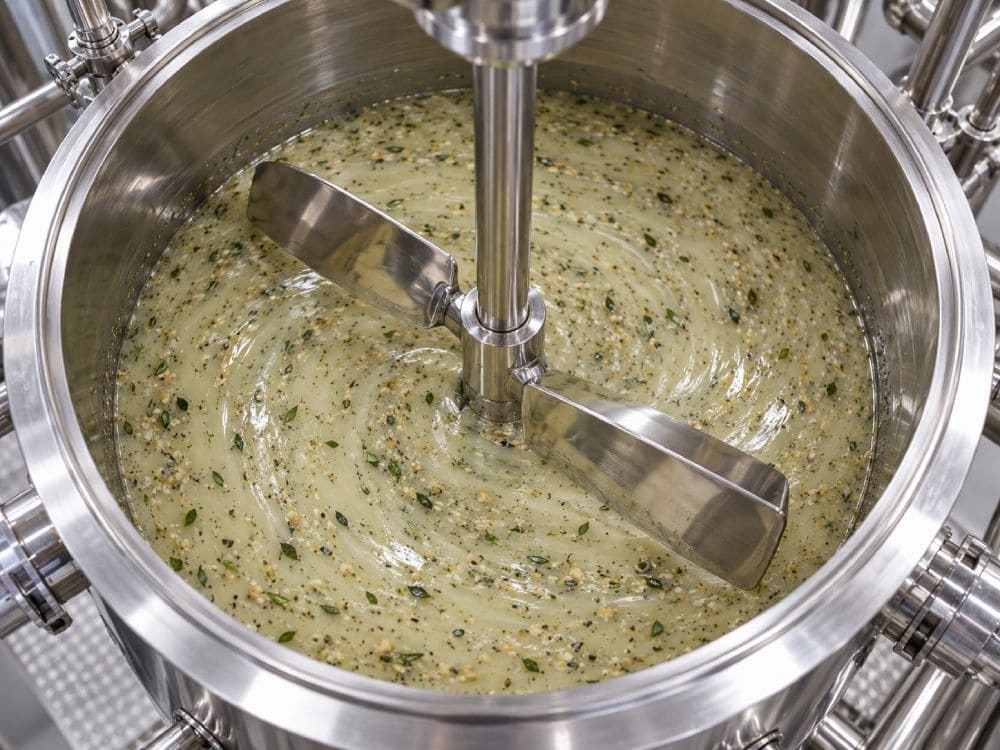
Many particulate-containing products are not stable suspensions. Given time, the solids will settle to the bottom of the supply tank while the liquid carrier rises to the top. When that happens, the first containers filled from the tank get more solids and less liquid, while the last containers get the opposite.
What you will see in production: Fill weights that are consistent by volume but inconsistent by product composition. The fill machine may be performing accurately by weight, but the product ratio is off across the batch.
What to do about it: Agitation in the supply tank is the standard solution. A slow-speed agitator keeps solids in suspension throughout the run without damaging the particles or introducing air. The agitation speed and style need to be matched to the product. Aggressive agitation can break down fragile particles or create foam. Gentle, low-shear agitation is usually the right approach for delicate products.
Nozzle Clogging & Incomplete Fills
Particulates that are large relative to the nozzle opening can cause partial or complete blockages. Even partial blockages affect fill accuracy, because a restricted nozzle delivers less product per fill cycle than a clear one.
What you will see in production: Gradual fill weight decline over the course of a run, with the machine appearing to operate normally but delivering progressively less product per container. In more severe cases, a nozzle blockage stops flow entirely and the operator has to clear it manually.
What to do about it: Nozzle selection matters significantly for particulate products. The nozzle opening needs to be large enough that particles can pass through without restriction, and the nozzle design should minimize areas where particles can accumulate. For products with large or irregular inclusions, a piston filler with a wide-bore nozzle is often the most reliable choice.
Shear Sensitivity & Pump Selection
Some products contain particles or structures that are damaged by high shear forces. Emulsions can break. Gel capsules can rupture. Fruit pieces can be crushed. When a pump creates too much shear, the product that arrives at the nozzle is not the same product that left the supply tank.
What you will see in production: Product quality issues in the finished container that are not present in the supply tank. The fill weights may be accurate, but the product is visually or texturally different from spec.
What to do about it: Shear-sensitive products require a low-shear pump type. Peristaltic pumps and piston pumps are generally the preferred options for products where particle integrity matters. Gear pumps and centrifugal pumps generate significantly more shear and are typically not appropriate for these applications.
How Formulation Changes Affect Your Filling Machine
Formulation changes are a normal part of product development. Suppliers change raw materials. Regulatory requirements shift. A product gets reformulated to improve shelf life, texture, or cost. From a filling standpoint, any change to the formulation is a potential change to how the product behaves in the machine, even when the change seems minor.
The mistake most operations make is treating a formulation change as a product-side decision that does not require a filling process review. It almost always does.
Small Changes with Large Accuracy Impacts
Even a modest change in the concentration of a thickening agent can shift a product's viscosity enough to move it outside the pump's optimal performance range. A change in the carrier fluid can affect surface tension and nozzle drip behavior. A change in fragrance or colorant may seem cosmetic but can affect how the product interacts with seals, pump components, or nozzle materials.
What you will see in production: A product that was running cleanly at established settings suddenly starts showing fill drift, dripping, or inconsistency after a reformulation.
What to do about it: Treat every formulation change as a trigger for a filling process review. Before the new formulation goes into production, run a calibration check at the established settings and compare results to the previous formulation. If fill weights have shifted, recalibrate before starting the full run. If the behavior has changed significantly, pump type and nozzle selection may need to be revisited.
Seasonal & Batch-to-Batch Variation
Even without intentional reformulation, products can vary between batches. Raw material quality, mixing time, water content, and production conditions all introduce variation. For operations filling products with tight accuracy requirements, batch-to-batch variation is a real source of fill inconsistency that cannot be fully solved through machine calibration alone.
What you will see in production: Fill weights that are well-controlled within a single batch but show variation from one batch to the next, even with the same machine settings.
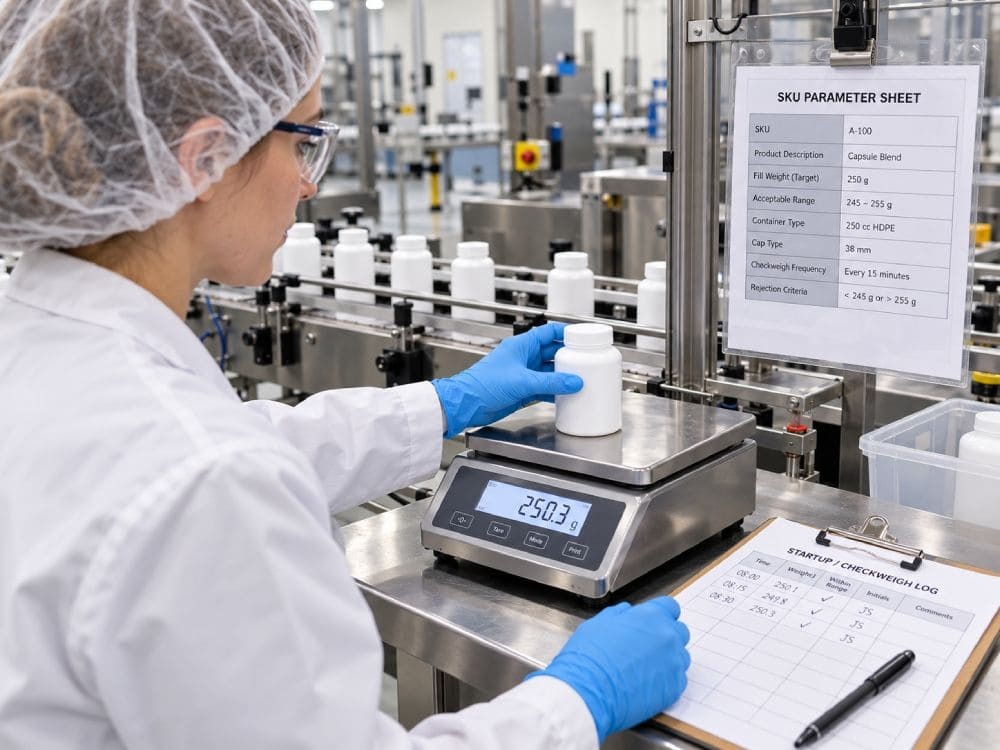
What to do about it: Build a startup calibration step into every batch run, not just at initial setup. A quick check-weight at the start of each new batch takes only a few minutes and catches variation before it affects the full run. For operations with tightly controlled accuracy requirements, documenting fill settings and check-weight results by batch creates a record that makes it easier to identify patterns and respond to drift proactively.
Keeping Settings Documented Across Formulations
Operations that run multiple formulations on the same equipment need a reliable way to store and retrieve settings for each product. Without documented settings, every changeover becomes a re-calibration exercise, and the results depend on which operator is doing it.
What to do about it: Maintain a fill settings log for each product that includes pump speed, fill time or volume, nozzle configuration, and any product-specific notes such as required temperature or agitation settings. Equipment with recipe storage makes this easier, but even a simple spreadsheet or laminated card at the machine is better than relying on operator memory. When a formulation changes, update the record and note what changed and why.
Key takeaway: The filling machine does not know when a formulation has changed. The operator does. Building a process that catches formulation-driven variation before it reaches finished containers is what separates operations that maintain accuracy from those that discover problems after the fact.
Frequently Asked Questions
How Do I Maintain Filling Accuracy Across Different Product Formulations?
Maintaining filling accuracy across different formulations requires matching the filling equipment to each product's characteristics and building calibration checks into the process. Start by understanding how each product's viscosity, temperature sensitivity, and particulate content affect flow behavior. Use pump types and nozzle configurations suited to each product, document the fill settings for each formulation, and run a check-weight at the start of every batch to catch variation before it affects the full run. Accuracy is not set once and forgotten. It is maintained through consistent process discipline across every run.
How Does Product Viscosity Affect Filling Machine Performance?
Viscosity directly controls how a product flows through the pump, hose, and nozzle. High-viscosity products move slowly, require more pump force to deliver, and are more prone to stringing or incomplete nozzle cutoff. Low-viscosity products move quickly and are harder to stop precisely, which increases the risk of overfills and dripping. A filling machine calibrated for one viscosity range will produce inaccurate results when asked to run a different product without recalibration. Pump type selection also matters. Piston and gear pumps are better suited to thick products, while peristaltic pumps work well for thin or shear-sensitive formulations.
What Causes Liquid Filling Inconsistency from One Run to the Next?
Inconsistency between runs is most often caused by product variation, temperature differences, or undocumented settings changes. If the product has changed between batches, even slightly, its flow behavior may be different. If the production environment is warmer or cooler than the previous run, a temperature-sensitive product will behave differently at the nozzle. If settings were adjusted during the last run and not documented, the starting point for the next run may not match what was actually working. The fix is a standardized startup process that includes a check-weight before full production begins, documented settings for each product, and a calibration review any time a formulation change has occurred.
Do I Need Different Filling Equipment for Different Product Types?
Not always, but the equipment needs to be configured appropriately for each product. A filling machine that handles a range of products well requires the right pump type for the viscosity range, nozzle options suited to the products being filled, and the ability to store and recall settings for each formulation. For operations running products with very different characteristics, such as thin solvents and thick creams on the same line, equipment flexibility and documented changeover procedures become especially important. In some cases, a product's characteristics are different enough that separate equipment configurations are the more practical solution.
How Do I Reduce Product Giveaway Caused by Fill Inaccuracy?
Product giveaway from overfilling is reduced by moving from operator-controlled fill stops to a filling system that controls the cutoff based on a defined volume or weight. Regular check-weights throughout the run catch drift before it compounds across a batch. For high-value formulations, even small improvements in fill accuracy translate directly to measurable cost savings. Even a small overfill on a high-volume line adds up to a significant amount of product given away every shift.
Maintain Fill Accuracy with Equipment That Fits Your Product
Fill accuracy problems across different formulations are not random. Viscosity, temperature, particulates, and formulation changes each create specific, identifiable challenges. Understanding what each one does to fill performance is the first step toward controlling it.
The second step is having equipment that is configured for the products you are actually filling, not just the product you started with.
At Oden Machinery, we work with manufacturers across a variety of industries to match liquid filling machines to their specific product requirements. Whether the challenge is a high-viscosity formulation, a particulate-heavy product, or a growing line with multiple SKUs running on the same machine, we have the equipment and the application knowledge to help.
Contact us today to discuss your product formulations and find a filling solution that maintains accuracy across your full product range.
