
 716.874.3000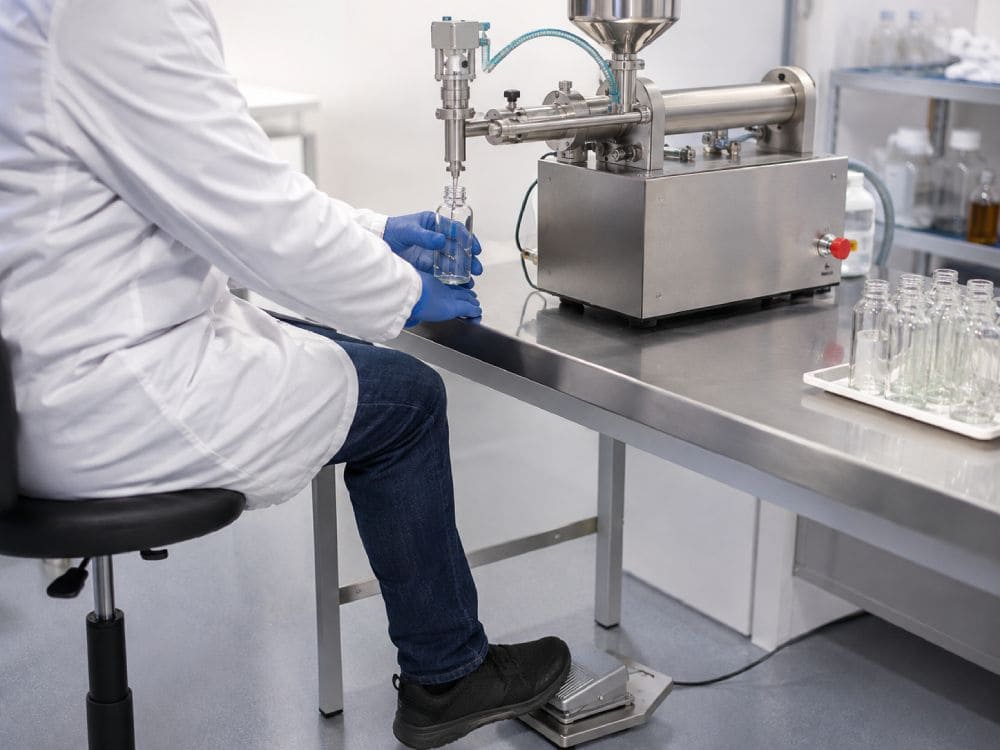
Choosing between a benchtop filler and a semi-automatic system is one of those decisions that looks simple on the surface but gets complicated quickly. Both options fill containers. Both can work with a wide range of products. But they are built for very different production environments, and putting the wrong one in place can cost more in lost time and rework than the equipment itself.
The real question is not which machine is better. It is which machine fits where the operation actually is right now, and where it is headed.
In this article, we will break down the differences between benchtop and semi-automatic filling machines, what factors push an operation from one category to the other, the volume thresholds that tend to signal it is time to upgrade, and what to consider before making the decision. If you are trying to figure out whether your current setup is still the right fit, this guide is for you.
In this guide:
- What Is a Benchtop Filling Machine?
- What Is a Semi-Automatic Filling Machine?
- Benchtop vs. Semi-Automatic: A Side-by-Side Comparison
- When Does a Benchtop Filler Stop Making Sense?
- Key Factors to Evaluate Before Making the Switch
- Signs It Is Time to Move from a Benchtop to a Semi-Automatic Filler
- FAQs
What Is a Benchtop Filling Machine?
A benchtop filling machine is a compact, tabletop-mounted filler designed for lower-volume production, lab environments, pilot runs, and operations where floor space is limited. These machines are typically operated by a single person and require direct operator involvement at every step of the fill cycle.
The operator places the container, initiates the fill, removes the filled container, and moves it to the next step. Some benchtop fillers are foot-pedal activated. Others use a simple trigger or lever. Controls are usually straightforward, and changeover from one product or container to another is often quick and tool-free.
What Benchtop Fillers Do Well
Benchtop machines are a practical fit in several situations:
- Small batch production where daily output is measured in dozens or low hundreds of containers
- Product development and pilot runs where fill parameters are still being tested
- Startups and early-stage operations that need a functional filling solution without a large capital commitment
- Multi-product facilities that fill small quantities of many different products and need fast changeover
- Specialty or custom products that do not justify a dedicated automated line
The lower cost of entry is a real advantage. A benchtop filler can get an operation running without the infrastructure, floor space, or capital that a semi-automatic system requires.
Where Benchtop Fillers Run into Limits
The same design that makes a benchtop filler accessible also limits it. Because the operator controls so much of the process, output is tied directly to how fast and consistently that person can work. Fatigue, shift changes, and fill-to-fill variation all affect throughput and accuracy.
When production volume increases, those limits become visible quickly. Fill weights start varying more than they should. Operators spend more time at the machine and less time on other tasks. Cleanup and downtime between runs start eating into the shift. The machine itself may still be functional, but the process around it starts to break down.
That is usually the first sign that the operation has grown past what a benchtop filler was designed to handle.
What Is a Semi-Automatic Filling Machine?
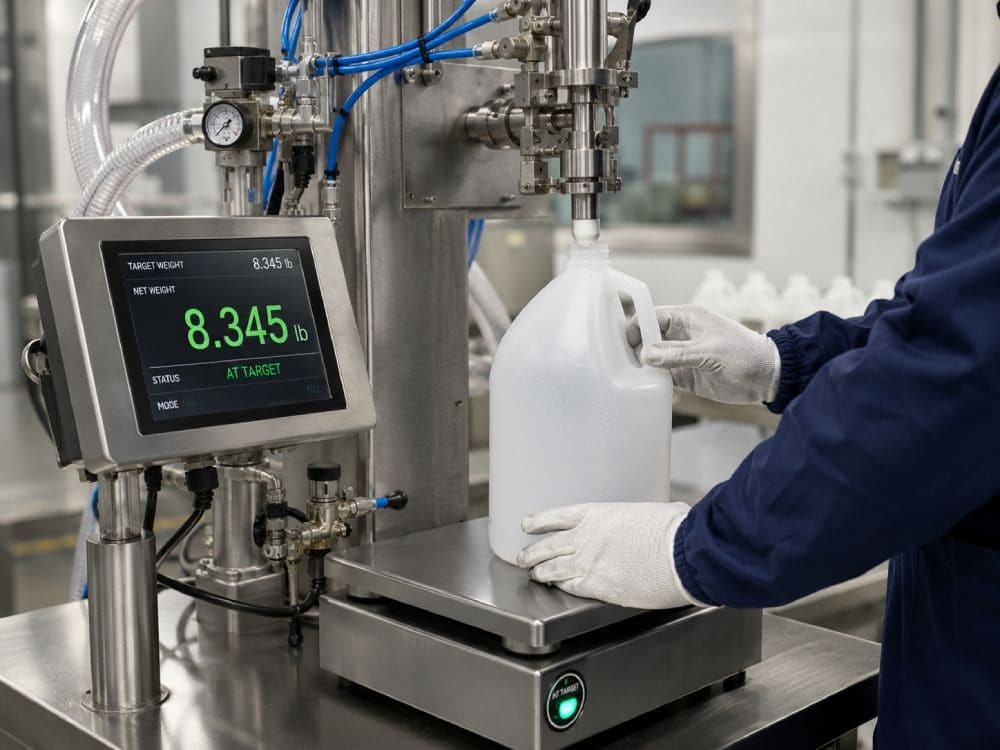
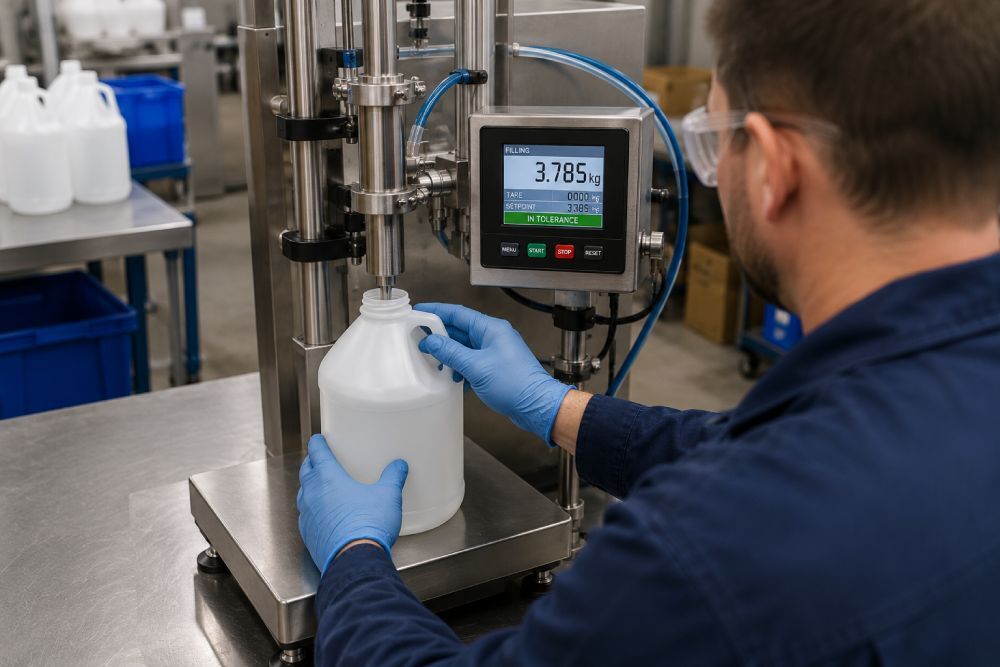
A semi-automatic filling machine automates the fill cycle itself while keeping the operator involved in container handling. The machine controls how much product is dispensed, how the fill profile runs, and when the nozzle cuts off. The operator loads the empty container, initiates the fill, and removes the filled container when the cycle is complete.
This division of labor matters. The machine handles the part of the process where consistency is most critical, which is the fill itself. The operator handles the parts that still require physical involvement but do not require the same precision.
The result is a meaningful step up in accuracy, repeatability, and sustainable throughput compared to a benchtop system, without the full capital investment of a completely automated line.
What Semi-Automatic Fillers Handle Better
Semi-automatic systems are designed for operations that have outgrown benchtop equipment but are not yet at the volume or budget level where full automation makes sense. They offer:
- Programmed fill control based on weight, volume, or a timed fill profile
- Consistent fill accuracy that does not depend on operator judgment from container to container
- Higher sustainable output because the machine controls the fill cycle rather than the operator
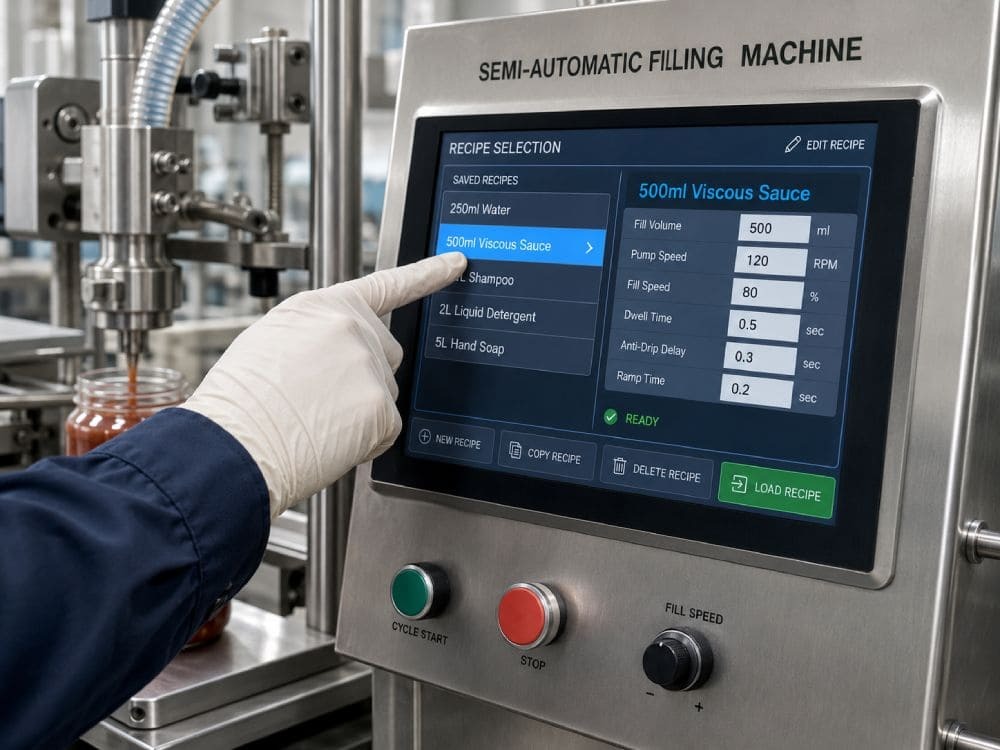
- Recipe storage for operations that run multiple products or container sizes
- Better drip control through positive shut-off nozzles and fill profiling features
- Scalability since many semi-automatic systems can be paired with conveyors, closing equipment, or additional fill heads as volume grows
For operations running hundreds to several thousand containers per shift, a semi-automatic filler typically delivers better accuracy, lower product giveaway, and more consistent output than a benchtop machine can sustain.
Benchtop vs. Semi-Automatic: A Side-by-Side Comparison
Both machine types can handle liquid filling across a wide range of products and container formats. The differences show up in how they handle volume, consistency, and operator dependency.
|
Factor |
Benchtop Filler |
Semi-Automatic Filler |
|
Typical daily output |
Dozens to low hundreds of containers |
Hundreds to several thousand containers |
|
Fill control |
Operator-controlled |
Machine-controlled (programmed) |
|
Fill accuracy |
Variable; depends on operator |
Consistent; repeatable cycle to cycle |
|
Operator involvement |
High; involved in every step |
Moderate; loads and unloads containers |
|
Floor space required |
Minimal; tabletop mounted |
Small to moderate footprint |
|
Capital investment |
Lower |
Moderate |
|
Scalability |
Limited |
Can grow with conveyors, closers, added heads |
|
Changeover |
Fast; usually tool-free |
Fast to moderate; recipe-based |
|
Best fit |
Startup, pilot, low-volume specialty |
Growing production with consistency needs |
|
Product giveaway risk |
Higher; fill variation adds up |
Lower; programmed cut-off reduces overfill |
|
Fatigue impact on output |
High; operator pace determines throughput |
Low; machine controls the fill cycle |
The Volume Decision Threshold: When Does a Benchtop Filler Stop Making Sense?
There is no single container count that automatically triggers an upgrade. The right threshold depends on the product, the container, the required fill accuracy, and how the operation is structured. That said, there are patterns that show up consistently when a benchtop filler has reached its limit.
Output Volume Alone Is Not the Only Signal
Volume matters, but it has to be evaluated alongside:
- Fill accuracy requirements: If customers, compliance, or cost of goods demand tight weight or volume tolerances, a benchtop filler's operator-dependent variation may be creating product giveaway or rejection risk on every run.
- Product value: The more valuable the product, the more expensive fill variation becomes. Even small, consistent overfills add up across a full shift.
- Labor cost and availability: If a dedicated operator is spending most of a shift at the benchtop filler, the labor cost of that arrangement may exceed the cost of a semi-automatic system within a reasonable payback window.
- Consistency requirements: Some customers, industries, or internal quality standards require documented fill accuracy that a benchtop filler cannot reliably deliver.
Practical Volume Ranges
While every operation is different, these ranges reflect where each machine type tends to perform well.
Benchtop fillers perform well when:
- Daily output is under 200 to 300 containers per shift
- Fill accuracy requirements are moderate and product value is relatively low
- Production is irregular, seasonal, or product mix changes frequently
- The operation is in early growth and capital is constrained
- The product is being tested or reformulated and fill parameters are not yet finalized
Semi-automatic fillers perform well when:
- Daily output consistently exceeds 300 to 500 containers per shift
- Fill accuracy requirements are tight and product giveaway is a measurable cost
- The same product or container runs regularly enough to benefit from stored recipes
- Labor at the benchtop filler is limiting other production tasks
- Customer or regulatory requirements demand documented fill consistency
These are starting points, not hard rules. The numbers have to be evaluated in context.
Key Factors to Evaluate Before Making the Switch
The volume threshold is a useful starting point, but it is not the whole picture. Before committing to a semi-automatic system, manufacturers should work through the following factors carefully. Each one can shift the decision in one direction or the other.
Product Characteristics
The product itself has a significant influence on which machine type performs well. Thin, free-flowing liquids are generally more forgiving on a benchtop filler because they dispense quickly and cleanly. Thick, viscous, or foamy products are harder to control manually and tend to benefit more from the programmed fill profiling that semi-automatic systems provide.
Products that foam may require a slow-fill stage at the end of the cycle to prevent overflow. A benchtop filler typically cannot deliver that kind of control reliably. A semi-automatic system with adjustable fill profiling can.
Container Format & Fill Volume
Smaller containers filled to low volumes are generally faster and easier to manage on a benchtop system. Larger containers, heavier fills, or containers that require precise positioning during the fill cycle put more strain on the operator and increase the risk of inconsistency.
If the operation fills containers that are awkward to position, prone to tipping, or heavy when full, ergonomics and accuracy become stronger cases for a semi-automatic system regardless of volume.
Changeover Frequency & Product Mix
One of the biggest strengths of benchtop fillers is their changeover flexibility. For operations that fill many different products in small quantities, the ability to rinse a nozzle and adjust a setting quickly is genuinely valuable.
Semi-automatic systems with recipe storage can match that flexibility at higher volumes. If the operation runs three to five products regularly, stored recipes eliminate the guesswork of re-dialing fill settings from scratch every time. The changeover advantage of a benchtop filler shrinks as the operation grows and recipe storage becomes more useful than manual adjustment.
Available Floor Space & Infrastructure
One of the real advantages of a benchtop filler is that it fits on a table. There is no floor space commitment, no need for utility connections beyond a power outlet, and no installation process beyond setting it up and plugging it in.
Semi-automatic systems require more space, though typically far less than a fully automated line. Before selecting a system, the facility layout should be reviewed to confirm there is adequate space for the machine, the operator's workflow, container staging, and any downstream steps like capping or labeling.
Growth Trajectory
If production volume has been increasing steadily over the past year, the relevant question is not just where the operation is today but where it will be in 12 to 18 months. Buying a benchtop filler to solve a problem that will outgrow it in six months means paying for equipment twice.
That said, a semi-automatic system is not a permanent solution for every operation either. For facilities that are growing quickly and expect to reach high-volume production within a few years, it is worth evaluating whether a semi-automatic system is the right intermediate step or whether the better investment is in a more scalable platform from the start.
Signs It Is Time to Move from a Benchtop to a Semi-Automatic Filler
Some of these signals are obvious. Others are easy to rationalize away until they become a bigger problem. If several of the following apply to the current operation, the benchtop filler has likely reached the end of its useful role.
- Fill weights are inconsistent from container to container, and the variation is large enough to affect product cost, compliance, or customer satisfaction.
- Operators are spending the majority of their shift at the filler, leaving little time for other production tasks.
- Product giveaway from overfilling has become a measurable cost, even if no one has formally calculated it.
- Production demands have increased but output has not kept pace, because the bottleneck is the filler and the operator running it.
- Customers or internal quality standards require tighter fill accuracy than the current process can reliably deliver.
- Cleanup and drip control are consuming significant time, particularly with viscous or messy products that are difficult to cut off cleanly by hand.
- Changeovers are becoming more frequent and more time-consuming as the product mix grows and manual re-adjustment takes longer.
- The operation is filling larger containers or heavier products, and ergonomic strain on the operator is becoming a concern.
- Production runs are becoming more predictable, with the same products and containers running regularly enough that stored recipes and programmed fill profiles would reduce setup time.
- A new customer or contract requires documented fill accuracy that the current benchtop process cannot support.
Benchtop vs. Semi-Automatic Filling Machine FAQs
What Is the Main Difference Between a Benchtop and a Semi-Automatic Filling Machine?
The main difference is where control over the fill cycle sits. A benchtop filler relies on the operator to initiate, monitor, and stop the fill, which means accuracy and throughput depend heavily on the person running the machine. A semi-automatic filler automates the fill cycle itself, using programmed settings to control how much product is dispensed and when the nozzle cuts off. The operator still loads and unloads containers, but the machine handles the fill.
Can a Benchtop Filler Deliver Accurate Fill Weights?
A benchtop filler can deliver reasonably consistent fills when the operator is attentive and the product is forgiving, but fill accuracy is ultimately limited by the operator's judgment and the machine's control capabilities. For applications that require tight, documented fill accuracy, a semi-automatic system with load cell-based net-weight filling or calibrated volumetric control is a more reliable solution.
Does Upgrading to a Semi-Automatic Filler Require a Full Line Redesign?
Not necessarily. Many semi-automatic fillers can be installed as a standalone upgrade and integrated into an existing workflow without a full line redesign. That said, it is worth reviewing the surrounding workflow when the filler changes. If the filler is faster and more consistent, the bottleneck may shift to container staging, capping, or labeling. Evaluating the full process before installing new equipment helps avoid trading one bottleneck for another.
Is Used Semi-Automatic Filling Equipment a Reliable Option?
High-quality used equipment that has been properly inspected, refurbished, and tested can deliver reliable performance at a lower cost than new equipment. The key is working with a supplier who can evaluate the machine's condition, confirm it is compatible with the product and container, and stand behind its performance after installation.
When Should an Operation Skip Semi-Automatic and Go Straight to Fully Automatic?
If production volume is already high and expected to grow further, if labor reduction is a primary goal, or if the operation runs a single product in long, repeatable runs, it may make more sense to evaluate fully automatic filling rather than treating semi-automatic as an intermediate step. Our automatic vs. semi-automatic filling machine comparison covers that decision in detail.
Choose Oden Machinery for Benchtop & Semi-Automatic Liquid Filling Equipment
The decision between a benchtop filler and a semi-automatic system is not about which machine is more advanced. It is about which machine fits the actual production environment, and whether the current setup is still serving the operation or quietly limiting it.
At Oden Machinery, we work with manufacturers to evaluate their filling requirements and find the right equipment for their product, container, and production environment. Whether that means a semi-automatic filler, a benchtop automation package, or a more integrated line configuration, we have the equipment and expertise to match the need.
Contact us today to talk through your filling requirements and find the right solution for your operation.
